
San Antonio Family Compound
The clients are a couple the architect had known for years. They originally met over 30 years ago when they were thrown together by circumstance when the client (single at that point) and the architect (and his fiancé) ended up partners in buying a large loft together in Soho in New York City and divided it in half. The client subsequently married and moved and sold his half of the loft years ago but he kept in touch; the architect designing a cabinet of Dr. Caligari-esque rumpus room in a home in a Chicago suburb for them and then bathrooms and other targeted work in a home outside of Princeton, New Jersey.
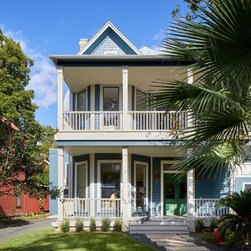
The client’s wife is originally from San Antonio. When they relocated from Princeton they were renting a place down the street and saw this property was available. The existing house had been broken up into apartments years before and was not in great shape. There were foundation issues and the second floor of the porch was missing entirely and had been for some time. There were additions from the 80s to the house on the side and back were nicely done but oriented back inward towards the house as at the time they were done the now beautiful river was probably a ditch of sorts. The site was also almost entirely covered with concrete painted green – now flaking away - with openings here and there for plantings.
The program was almost completely determined from the outset of the project. The existing house was to have homes for their older daughter and her grandmother in the main house and to have two outbuildings: one that contained the garage and a glass studio and the other the guest house that they would live in.
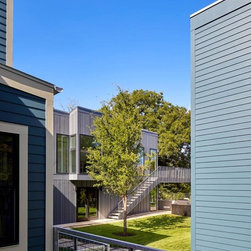
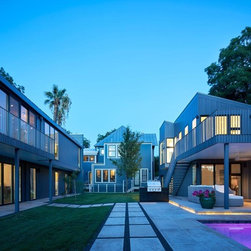
The architect and his clients came up with the courtyard approach quickly – it seemed fairly obvious - the two bars of the new building and the addition on the back of the existing house forming three sides of the courtyard overlooking the river. The canted plan (shifting the two new structures in relation to one another) came a little later in the design process, creating more of a dynamic relationship between them and also responding more directly to the angled geometry of the river on the West End of the site. Originally they looked at the two structures being built offsite and brought in as modular units but the usable widths of them grew beyond what made sense for that approach and they were built conventionally on site.
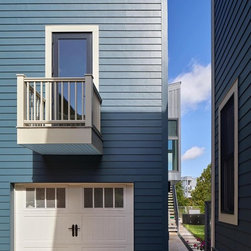
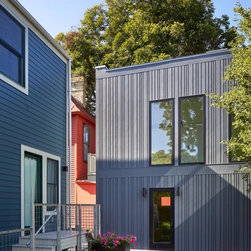
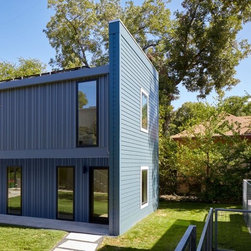
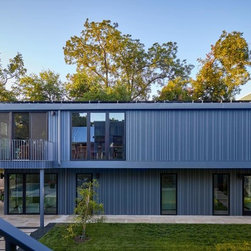
The new additions to the original house, the two-story “tower” on the north side and the two-story addition on the river side, are detailed to match the original house. This is also true of facades on the neighborhood side of the new structures that match the color, scale and character of the existing house. These facades also shield the sloped roofs and the solar panels that populate them from the street.
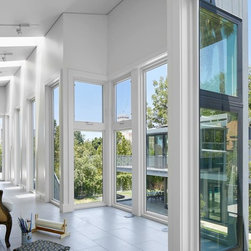
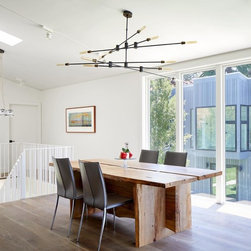
The architect’s clients always wanted the new buildings to be modern. The glass studio and living areas are on the upper floors of their respective structure to take advantage of the long views along and across the river. Both of these second floor spaces are open, loft-like areas with strategically located skylights and with the slope of the roof apparent from the interior.
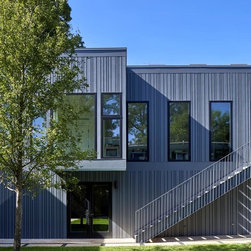
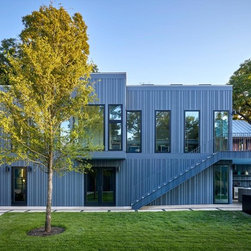
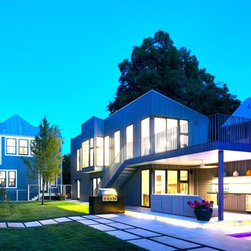
After looking at vertical corrugated steel and also different rain screen configurations that were abandoned for aesthetic and/or functional reasons the architect came up with the randomly spaced “reverse board and batten” siding for the two structures. The intent was to have a taut, flat surface irregularly interrupted to create a finer scale (that might typically be done in a non-modern design with casings and shingles) in a non-traditional way.
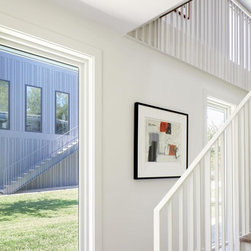
The steel railings both inside and out of the new structures have a subtle random staggering of the depth of the vertical elements in plan that keep the regular 4 inch spacing of the balusters but obliquely have the feel of the random pattern on the siding.
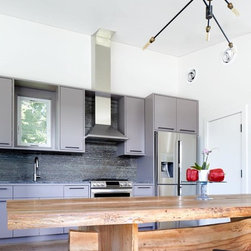
The interior finishes are for the most part kept simple but with character, like the bleached walnut floors in the Guest House and large format pavers in the Glass Studio. However, idiosyncrasies have been added like the decorative concrete tiles in the Guest House bathroom floors and the unusual (and highly visible) stone backsplash in the Guest House kitchen. Other incidental decorative treatments have been added throughout the Main House as well.
In the design for the landscaping local Lueders stone pavers were used extensively – both as tight-jointed surface patios and set in grass as large stepping stones between the three buildings on the courtyard. A lot of (mostly unseen) effort was put into the grading, paving and edging in order for the relatively flat site to drain properly. A small swimming pool is located on the southwest corner of the site with an outdoor kitchen and grille. Existing trees were saved where we could and new trees and bushes have been planted across the entire site to either direct or protect views in and out of the rooms in the buildings.
The client’s wife is originally from San Antonio. When they relocated from Princeton they were renting a place down the street and saw this property was available. The existing house had been broken up into apartments years before and was not in great shape. There were foundation issues and the second floor of the porch was missing entirely and had been for some time. There were additions from the 80s to the house on the side and back were nicely done but oriented back inward towards the house as at the time they were done the now beautiful river was probably a ditch of sorts. The site was also almost entirely covered with concrete painted green – now flaking away - with openings here and there for plantings.
The program was almost completely determined from the outset of the project. The existing house was to have homes for their older daughter and her grandmother in the main house and to have two outbuildings: one that contained the garage and a glass studio and the other the guest house that they would live in.
The architect and his clients came up with the courtyard approach quickly – it seemed fairly obvious - the two bars of the new building and the addition on the back of the existing house forming three sides of the courtyard overlooking the river. The canted plan (shifting the two new structures in relation to one another) came a little later in the design process, creating more of a dynamic relationship between them and also responding more directly to the angled geometry of the river on the West End of the site. Originally they looked at the two structures being built offsite and brought in as modular units but the usable widths of them grew beyond what made sense for that approach and they were built conventionally on site.
The new additions to the original house, the two-story “tower” on the north side and the two-story addition on the river side, are detailed to match the original house. This is also true of facades on the neighborhood side of the new structures that match the color, scale and character of the existing house. These facades also shield the sloped roofs and the solar panels that populate them from the street.
The architect’s clients always wanted the new buildings to be modern. The glass studio and living areas are on the upper floors of their respective structure to take advantage of the long views along and across the river. Both of these second floor spaces are open, loft-like areas with strategically located skylights and with the slope of the roof apparent from the interior.
After looking at vertical corrugated steel and also different rain screen configurations that were abandoned for aesthetic and/or functional reasons the architect came up with the randomly spaced “reverse board and batten” siding for the two structures. The intent was to have a taut, flat surface irregularly interrupted to create a finer scale (that might typically be done in a non-modern design with casings and shingles) in a non-traditional way.
The steel railings both inside and out of the new structures have a subtle random staggering of the depth of the vertical elements in plan that keep the regular 4 inch spacing of the balusters but obliquely have the feel of the random pattern on the siding.
The interior finishes are for the most part kept simple but with character, like the bleached walnut floors in the Guest House and large format pavers in the Glass Studio. However, idiosyncrasies have been added like the decorative concrete tiles in the Guest House bathroom floors and the unusual (and highly visible) stone backsplash in the Guest House kitchen. Other incidental decorative treatments have been added throughout the Main House as well.
In the design for the landscaping local Lueders stone pavers were used extensively – both as tight-jointed surface patios and set in grass as large stepping stones between the three buildings on the courtyard. A lot of (mostly unseen) effort was put into the grading, paving and edging in order for the relatively flat site to drain properly. A small swimming pool is located on the southwest corner of the site with an outdoor kitchen and grille. Existing trees were saved where we could and new trees and bushes have been planted across the entire site to either direct or protect views in and out of the rooms in the buildings.
Project Year: 2017
Project Cost: $1,500,001 - $2,000,000
Country: United States