
Scarsdale Traditional Library Renovation
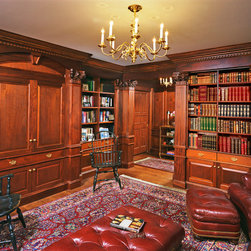
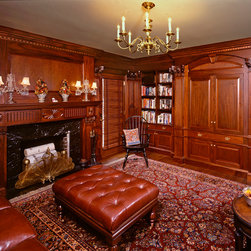
Totally renovated library.
The homeowners lived in a classic, 1915 colonial house in Scarsdale, NY. They felt it was time to upgrade their library, including adding a new media center. This library was particularly challenging due to the owner’s love for American colonial architecture. Deborah Goldreyer had already designed their new kitchen, breakfast room, family room and stair hall; all incorporating colonial styling that integrated with the existing house. The new library design, with the conflicting desire for new technology and authentic colonial design, was a big challenge.
“We knew this house so intimately,” said Goldreyer. “We also knew the homeowners’ preferred architectural style. So we started the design process with presenting colonial precedents that would be an acceptable stylistic direction for the library/media project.”
Room Design - Capitals
After establishing the general design of the room, the project needed to be refined into a final, coordinated architectural design. Since the columns acted as a repeating, unifying element, it was particularly important challenge getting the right proportions for this millwork. The ceiling height of this library was low and it was decided that the typical column dimensions needed to be adjusted accordingly, including the capitals. The column capitals that had been selected by the homeowners during initial design discussions were more appropriate for a taller space. We made very careful adjustments to the components of the capital in order to create better proportions for the actual room. With very detailed drawings sent to the woodworking shop, a full scale column capital was carved by hand and sent back for review and approval. The capitals were copied from this original by using an advanced laser guided cutting technique that produced an additional 14 capitals. They were all identical until each was hand carved with unique characteristics to create a totally handmade look.
Room Design - Other Unifying Elements
As with the column capitals, the type of crown molding favored by the homeowners needed to be modified for this space. Using a set of molding pieces available in mahogany, Goldreyer created a custom crown molding design, including dentils, that was stylistically consistent as well as specifically proportioned for this room.
“The columns, capitals, fascia and crown moldings were the main elements that really united the whole space,” said Goldreyer. “Using the top of the walls for organizational purposes is key because these elements are not obstructed and therefore highly visible. In addition, there were other, more subtle elements that united the room design, too.”
Thin, wood moldings were added above and below the drawers thus creating parallel bands around the entire room. This not only unified the room, it also added a subtle interruption and double reading of the columns. At this interruption, the column face changed from fluted to flat. This allowed the columns to be read as complete from the drawer level up (the most visible portion) as well as from the floor up, depending on the particular view and placement of furnishings. Further unity was provided by the same raised panels and base moldings being used at both the cabinet doors as well as the wainscoting.
“All these unifying elements were very important,” insisted Goldreyer’s partner Bart Hamlin. “The room had an irregular L-shape and the walls were interrupted with two doors, three windows, the fireplace and the entertainment center. Without these unifiers, the room would have felt quite chaotic.”
Special elements – Fireplace and Media Center
With sufficient unifying details to keep the whole room architecturally organized, the architects then focused on the focal points: the fireplace and the media center. The fireplace needed to be a special focal point for two reasons: 1) fireplaces are the traditional focus of this type of room and; 2) When the media center cabinet was in the open, viewing position, it was very important the room maintained its strong traditional identity with its focus at the fireplace.
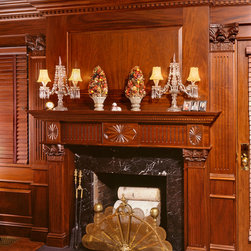
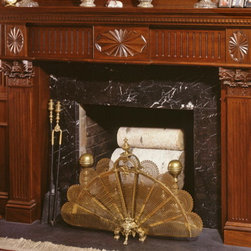
The fireplace surround repeated the fluted column motif. The fireplace columns were shorter and the capitals were smaller but both were designed to be proportionately similar to the larger versions elsewhere in the room. The fireplace column fluting was uninterrupted thus giving special significance to this important focal point.. The frieze of the mantel was given decorative medallions which also enhanced this area compared to the plain fascia above. The molding over the frieze purposefully recalled the crown molding with dentils used at the top of the walls.
“The media center needed to be special,” said Hamlin. “But it also needed to blend into the room and allow the fireplace to be the traditional, honorific focus.”
Accordingly, the columns flanking the media center were the same as the others in the room. Also, the parallel trims and raised panels were the same as elsewhere. What was different was the arch and keystone. These elements quietly accentuated the media center as a special place. Cleverly, this demarcation is visible when the cabinets are both open and closed. Unseen, but very functional details at the media center included special storage drawers, full extension cabinet shelving with custom dividers, hidden telephone system, and doors at the upper cabinet that recessed back into the cabinet allowing for unobstructed viewing.
A final design subtlety was added by Goldreyer. The fireplace and media center elements were pulled forward from the walls. This allowed the columns to project out into the room slightly. It allowed for the fascia and crown at both locations to project out, too. This very subtle touch gives a break to long lengths of crown moldings, allows the moldings to be seen in profile, and further accentuates the importance of these two major elements of the room.
“We believe there need to be many levels of architectural design in a room like this,” explained Goldreyer. “The homeowner may not notice some of the subtle touches right away. But when they do, we hope they will be delighted.”
The homeowners lived in a classic, 1915 colonial house in Scarsdale, NY. They felt it was time to upgrade their library, including adding a new media center. This library was particularly challenging due to the owner’s love for American colonial architecture. Deborah Goldreyer had already designed their new kitchen, breakfast room, family room and stair hall; all incorporating colonial styling that integrated with the existing house. The new library design, with the conflicting desire for new technology and authentic colonial design, was a big challenge.
“We knew this house so intimately,” said Goldreyer. “We also knew the homeowners’ preferred architectural style. So we started the design process with presenting colonial precedents that would be an acceptable stylistic direction for the library/media project.”
Room Design - Capitals
After establishing the general design of the room, the project needed to be refined into a final, coordinated architectural design. Since the columns acted as a repeating, unifying element, it was particularly important challenge getting the right proportions for this millwork. The ceiling height of this library was low and it was decided that the typical column dimensions needed to be adjusted accordingly, including the capitals. The column capitals that had been selected by the homeowners during initial design discussions were more appropriate for a taller space. We made very careful adjustments to the components of the capital in order to create better proportions for the actual room. With very detailed drawings sent to the woodworking shop, a full scale column capital was carved by hand and sent back for review and approval. The capitals were copied from this original by using an advanced laser guided cutting technique that produced an additional 14 capitals. They were all identical until each was hand carved with unique characteristics to create a totally handmade look.
Room Design - Other Unifying Elements
As with the column capitals, the type of crown molding favored by the homeowners needed to be modified for this space. Using a set of molding pieces available in mahogany, Goldreyer created a custom crown molding design, including dentils, that was stylistically consistent as well as specifically proportioned for this room.
“The columns, capitals, fascia and crown moldings were the main elements that really united the whole space,” said Goldreyer. “Using the top of the walls for organizational purposes is key because these elements are not obstructed and therefore highly visible. In addition, there were other, more subtle elements that united the room design, too.”
Thin, wood moldings were added above and below the drawers thus creating parallel bands around the entire room. This not only unified the room, it also added a subtle interruption and double reading of the columns. At this interruption, the column face changed from fluted to flat. This allowed the columns to be read as complete from the drawer level up (the most visible portion) as well as from the floor up, depending on the particular view and placement of furnishings. Further unity was provided by the same raised panels and base moldings being used at both the cabinet doors as well as the wainscoting.
“All these unifying elements were very important,” insisted Goldreyer’s partner Bart Hamlin. “The room had an irregular L-shape and the walls were interrupted with two doors, three windows, the fireplace and the entertainment center. Without these unifiers, the room would have felt quite chaotic.”
Special elements – Fireplace and Media Center
With sufficient unifying details to keep the whole room architecturally organized, the architects then focused on the focal points: the fireplace and the media center. The fireplace needed to be a special focal point for two reasons: 1) fireplaces are the traditional focus of this type of room and; 2) When the media center cabinet was in the open, viewing position, it was very important the room maintained its strong traditional identity with its focus at the fireplace.
The fireplace surround repeated the fluted column motif. The fireplace columns were shorter and the capitals were smaller but both were designed to be proportionately similar to the larger versions elsewhere in the room. The fireplace column fluting was uninterrupted thus giving special significance to this important focal point.. The frieze of the mantel was given decorative medallions which also enhanced this area compared to the plain fascia above. The molding over the frieze purposefully recalled the crown molding with dentils used at the top of the walls.
“The media center needed to be special,” said Hamlin. “But it also needed to blend into the room and allow the fireplace to be the traditional, honorific focus.”
Accordingly, the columns flanking the media center were the same as the others in the room. Also, the parallel trims and raised panels were the same as elsewhere. What was different was the arch and keystone. These elements quietly accentuated the media center as a special place. Cleverly, this demarcation is visible when the cabinets are both open and closed. Unseen, but very functional details at the media center included special storage drawers, full extension cabinet shelving with custom dividers, hidden telephone system, and doors at the upper cabinet that recessed back into the cabinet allowing for unobstructed viewing.
A final design subtlety was added by Goldreyer. The fireplace and media center elements were pulled forward from the walls. This allowed the columns to project out into the room slightly. It allowed for the fascia and crown at both locations to project out, too. This very subtle touch gives a break to long lengths of crown moldings, allows the moldings to be seen in profile, and further accentuates the importance of these two major elements of the room.
“We believe there need to be many levels of architectural design in a room like this,” explained Goldreyer. “The homeowner may not notice some of the subtle touches right away. But when they do, we hope they will be delighted.”