

Upper Eastside Modern Townhouse
The success of a project is often predicated on the designer’s ability to communicate his ideas. This is particularly true when the clients are architecture aficionados. The couple and their teenage twins were almost as interested in the design process as they were in the end product. Originally, the family asked my opinion about modifying closets in a penthouse they intended to buy. Realizing that they would likely outgrow the space quickly, I gently suggested they reconsider, and instead purchase a townhouse, allowing for more flexibility, greater customization and possibly better investment value.
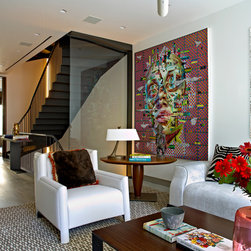
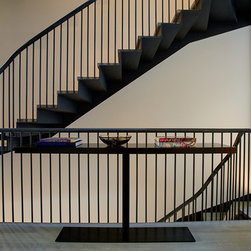
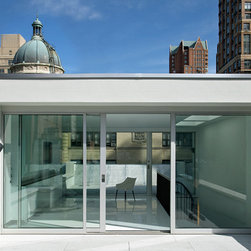
They found a two-family townhouse that needed extensive work. Designed in the 1920s, its interiors were compartmentalized into confining areas. Our goal was to create a series of open and livable spaces. To maximize the house’s perceived width, we created a skeletal stair and cantilevered it off the east wall. The decision not to enclose the stairs by walls on both sides, gained us almost a foot in interior width. The stair became the focal point of every room it passes through. It is the spine of the home, running from the basement up to the roof, where we added a glass penthouse. The penthouse skylights spill an abundance of sunshine into a six-story light-well.
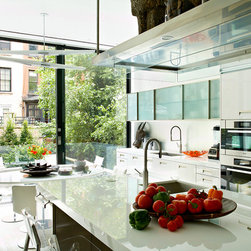
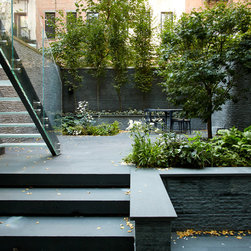
As the beauty of townhouse living is the home’s rear view on to lush garden terraces and the interaction of neighbors who tend to them, we chose expansive floor to ceiling glass for the back of the house. We also enlarged the windows on the front facade, making the house feel connected to its location in both directions with site lines from front to back, allowing natural daylight to flood deep into the center of the home.
The color of the architectural materials progressively lightens as one ascends each floor, a visual narrative of man’s goal towards self-improvement, beckoning Jean-Paul Sartre’s quote: “Man is not the sum of what he has already, but rather the sum of what he does not yet have, of what he could have."
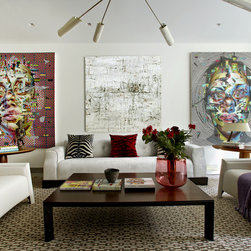
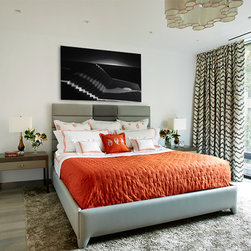
At the basement level, the stairwell’s interior walls are blackened steel and the family room cabinetry is made of ebonized wood. (Even the outdoor garden is paved in black granite.) The living room at the second floor contains a bleached grey Macassar mantle sealed under seven coats of high-gloss lacquer, while the media room is paneled in wenge, cerused and limed to emphasize its grain. The bedrooms suites on the third and fourth levels contain dressing rooms, closets and wall units made from a variety of pale grey woods. Finally, the children’s room and penthouse feature white lacquer built-ins and floors of white milk glass.
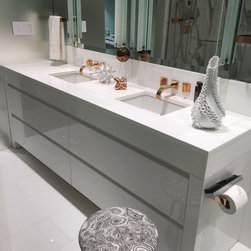
The house is a uniform modernist composition that maintains an exacting standard of detail at the micro-level. Lasers were used for tasks that required precision, from aligning structural beams to laying out stone and tile. Many utilitarian features are concealed (the drawers throughout the house have hidden pulls). Others details are barely visible but serve important roles, like the recessed polished nickel C-channels at the baseboards that make the walls appear to float. The overall feel is that of complete exposure – with the aperture wide open -- as if to say, there is no need to display opulence, for it resides within.
They found a two-family townhouse that needed extensive work. Designed in the 1920s, its interiors were compartmentalized into confining areas. Our goal was to create a series of open and livable spaces. To maximize the house’s perceived width, we created a skeletal stair and cantilevered it off the east wall. The decision not to enclose the stairs by walls on both sides, gained us almost a foot in interior width. The stair became the focal point of every room it passes through. It is the spine of the home, running from the basement up to the roof, where we added a glass penthouse. The penthouse skylights spill an abundance of sunshine into a six-story light-well.
As the beauty of townhouse living is the home’s rear view on to lush garden terraces and the interaction of neighbors who tend to them, we chose expansive floor to ceiling glass for the back of the house. We also enlarged the windows on the front facade, making the house feel connected to its location in both directions with site lines from front to back, allowing natural daylight to flood deep into the center of the home.
The color of the architectural materials progressively lightens as one ascends each floor, a visual narrative of man’s goal towards self-improvement, beckoning Jean-Paul Sartre’s quote: “Man is not the sum of what he has already, but rather the sum of what he does not yet have, of what he could have."
At the basement level, the stairwell’s interior walls are blackened steel and the family room cabinetry is made of ebonized wood. (Even the outdoor garden is paved in black granite.) The living room at the second floor contains a bleached grey Macassar mantle sealed under seven coats of high-gloss lacquer, while the media room is paneled in wenge, cerused and limed to emphasize its grain. The bedrooms suites on the third and fourth levels contain dressing rooms, closets and wall units made from a variety of pale grey woods. Finally, the children’s room and penthouse feature white lacquer built-ins and floors of white milk glass.
The house is a uniform modernist composition that maintains an exacting standard of detail at the micro-level. Lasers were used for tasks that required precision, from aligning structural beams to laying out stone and tile. Many utilitarian features are concealed (the drawers throughout the house have hidden pulls). Others details are barely visible but serve important roles, like the recessed polished nickel C-channels at the baseboards that make the walls appear to float. The overall feel is that of complete exposure – with the aperture wide open -- as if to say, there is no need to display opulence, for it resides within.
Country: United States