Gully Washer between Two Homes
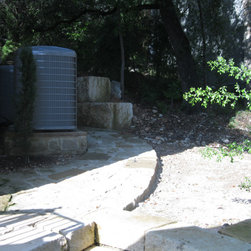
A development upslope from one of my clients had increased the impervious cover and cleared the slope of its Ashe junipers (cedars). The result was a massive gully washer formed downslope between my client's home and their neighbor’s. During a flood, waters would rush down this gully that had eroded down to hardpan caliche, and straight into another neighbor’s front door. The typical, engineered solution would have been to pipe the water under the driveway to the downslope concrete drainage inlet. This would have diverted the problem, but it would not have solved it. I wanted to design a sustainable system that would solve the problem and utilize biomimicry.
So, I looked at what I already knew. For one, I know that the stair stepped terrain in the Hill Country helps to slow overland water flows from our frequent flash floods. At the smaller scale, I know the dense canopies of trees, such as Ashe junipers and live oaks, break the impact of rain on slopes, and that a dense cover of grasses and matted leaf litter slows overland flows. Looking deeper, I also know a large percent of water captured by the tree canopies flows down the trunks, enters the soil and travels deep along larger tree roots.
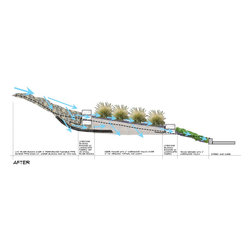
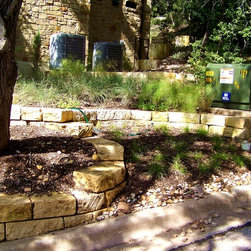
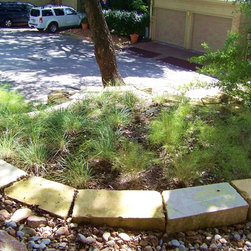
I then applied my knowledge to solve the problem. Having only a narrow space between the two homes, I had to go more vertical than horizontal. So, I duplicated the function of tree roots with a downward sloping perforated pipe and I added terraces, deep, organic soil and dense, native muhlies and sedges to slow overland flows and allow for deep infiltration.
Once installed, Austin was hit with the October floods of 2013. I drove to the site a few days later and it was as if no flooding had occurred. Not one piece of mulch…not one rock…nothing…had been washed down. After several severe floods, the design still serves has a functional, sustainable system, growing stronger with time.
So, I looked at what I already knew. For one, I know that the stair stepped terrain in the Hill Country helps to slow overland water flows from our frequent flash floods. At the smaller scale, I know the dense canopies of trees, such as Ashe junipers and live oaks, break the impact of rain on slopes, and that a dense cover of grasses and matted leaf litter slows overland flows. Looking deeper, I also know a large percent of water captured by the tree canopies flows down the trunks, enters the soil and travels deep along larger tree roots.
I then applied my knowledge to solve the problem. Having only a narrow space between the two homes, I had to go more vertical than horizontal. So, I duplicated the function of tree roots with a downward sloping perforated pipe and I added terraces, deep, organic soil and dense, native muhlies and sedges to slow overland flows and allow for deep infiltration.
Once installed, Austin was hit with the October floods of 2013. I drove to the site a few days later and it was as if no flooding had occurred. Not one piece of mulch…not one rock…nothing…had been washed down. After several severe floods, the design still serves has a functional, sustainable system, growing stronger with time.
Country: United States