
Outdoor Living Space
What began as a simple request to recommend a more durable decking material led to in-depth discussion about outdoor living opportunities for this retired couple’s existing backyard property. With children and grandchildren constantly dropping in for extended visits, the couple discussed their goals for an organized yet straightforward outdoor living space that would be safe for toddlers and encourage family interaction, yet still be appropriate for entertaining adult friends as well.
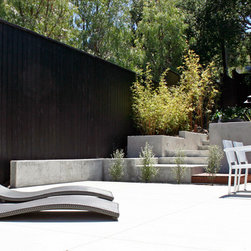
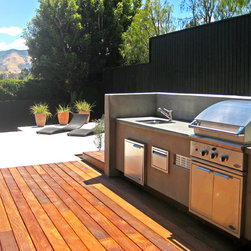
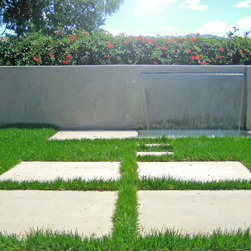
Challenged with significant grade changes, existing high-maintenance materials, and mixed-match landscaping, the owners eventually sought to completely renovate their yard into an outdoor living space that would provide a seamless extension of their indoor living area. En route to achieving these goals, the rear yard was reorganized into zones of formal and semi-formal areas, delineated by simple material changes, terraces, and plant materials. The worn-out “Weber”, which had been previously relegated to a dark corner of the yard, was replaced with a built-in outdoor kitchen, complete with modern appliances and concrete countertops.
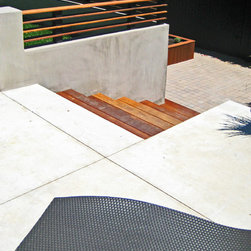
As part of their sustainability goals for this renovation, the owners wanted to ensure provisions for a vegetable and herb garden that would appear as a natural extension of the newly organized outdoor space, yet designed to be easily accessible for both planting and harvesting. This was achieved using raised planters organized in the lower terrace, built from sustainably-harvested Brazilian hardwood, which was also sparingly utilized for terrace rails and steps.
The resultant efforts turned this previously dysfunctional backyard into an organized and highly-utilized outdoor living environment.
Challenged with significant grade changes, existing high-maintenance materials, and mixed-match landscaping, the owners eventually sought to completely renovate their yard into an outdoor living space that would provide a seamless extension of their indoor living area. En route to achieving these goals, the rear yard was reorganized into zones of formal and semi-formal areas, delineated by simple material changes, terraces, and plant materials. The worn-out “Weber”, which had been previously relegated to a dark corner of the yard, was replaced with a built-in outdoor kitchen, complete with modern appliances and concrete countertops.
As part of their sustainability goals for this renovation, the owners wanted to ensure provisions for a vegetable and herb garden that would appear as a natural extension of the newly organized outdoor space, yet designed to be easily accessible for both planting and harvesting. This was achieved using raised planters organized in the lower terrace, built from sustainably-harvested Brazilian hardwood, which was also sparingly utilized for terrace rails and steps.
The resultant efforts turned this previously dysfunctional backyard into an organized and highly-utilized outdoor living environment.