
Pergolas: When Throwing a Little Shade is a Good Thing
Perhaps it's our cold winters. Or our great shorelines, rivers and lakes. Whatever the reason, in the northeast we love summer sun. We revel in sunny water sports, sunbathing, barbecues, etc. Yet, while enjoying the outdoors, there are times when we look for an escape from the sun and are grateful for something that will throw us a little shade.
A shade umbrella can often fit the bill. But unless you have a bank of them, or are seated together at a dining table, they are really only good for one person and they don’t offer the architectural beauty of a built structure. Cabanas and pavilions offer substantial and roomy breaks from the sun, but these may require permits and considerable planning to design/build.
It’s not surprising, then, that many find the simplest solution for some shade is the elegant pergola. “Pergolas are considered decorative or ornamental, so they rarely require permits,” says Dave Stockwell, owner of Deck and Patio. “And their construction is fairly straightforward, especially when using a prefabricated kit.
“While we do build a lot of pavilions and cabanas, etc., just as frequently, clients opt for the less complicated pergola. Occasionally, those that already have a cabana or pavilion want a little extra shade thrown in another outdoor area.”
Deck and Patio has found that clients also love the pergola’s open design. “Whether it’s made of vinyl, cedar, or fiberglass, etc., the structure allows for refreshing cross currents of air, yet is elegant enough to frame a picture-perfect outdoor sitting/gathering area,” adds Stockwell. "Plus, because of their simple design, you can expand them to fit pretty much any size space."
What Exactly Defines a Pergola?
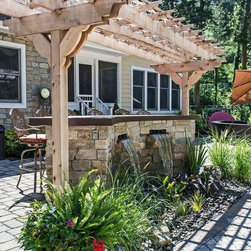
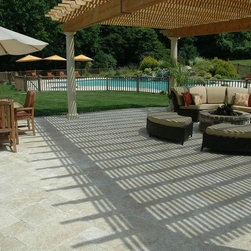
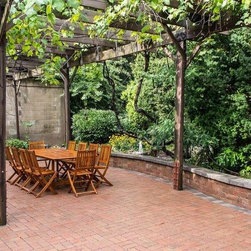
A pergola is constructed with open rafters at the top and is supported by posts. It’s usually of simple, durable construction and is free standing.
“We find the two most popular pergola materials are vinyl and cedar,” says Stockwell. “Vinyl is usually white or cream in tone. Both are resistant to weather, rot and insects, although vinyl is completely immune to such deterioration.”
In the end, some clients prefer the handsome look of wood, and find they don’t mind periodic refinishing, which is necessary with natural wood structures (even cedar will require occasional staining and a sealant, otherwise its color will change over time), while others want a maintenance-free structure and choose vinyl.”
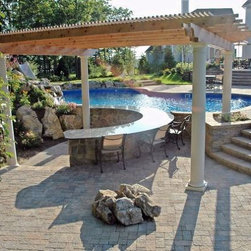
According to Stockwell, when deciding where you will place the pergola, consider where you will want shade most often — e.g., over a new outdoor bar, seating area, or barbecue. Then, so as to capture the right amount of shade from the pergola’s rafters, take note how the sun passes over your yard before deciding where to position it all, and at what angle, etc.
A shade umbrella can often fit the bill. But unless you have a bank of them, or are seated together at a dining table, they are really only good for one person and they don’t offer the architectural beauty of a built structure. Cabanas and pavilions offer substantial and roomy breaks from the sun, but these may require permits and considerable planning to design/build.
It’s not surprising, then, that many find the simplest solution for some shade is the elegant pergola. “Pergolas are considered decorative or ornamental, so they rarely require permits,” says Dave Stockwell, owner of Deck and Patio. “And their construction is fairly straightforward, especially when using a prefabricated kit.
“While we do build a lot of pavilions and cabanas, etc., just as frequently, clients opt for the less complicated pergola. Occasionally, those that already have a cabana or pavilion want a little extra shade thrown in another outdoor area.”
Deck and Patio has found that clients also love the pergola’s open design. “Whether it’s made of vinyl, cedar, or fiberglass, etc., the structure allows for refreshing cross currents of air, yet is elegant enough to frame a picture-perfect outdoor sitting/gathering area,” adds Stockwell. "Plus, because of their simple design, you can expand them to fit pretty much any size space."
What Exactly Defines a Pergola?
A pergola is constructed with open rafters at the top and is supported by posts. It’s usually of simple, durable construction and is free standing.
“We find the two most popular pergola materials are vinyl and cedar,” says Stockwell. “Vinyl is usually white or cream in tone. Both are resistant to weather, rot and insects, although vinyl is completely immune to such deterioration.”
In the end, some clients prefer the handsome look of wood, and find they don’t mind periodic refinishing, which is necessary with natural wood structures (even cedar will require occasional staining and a sealant, otherwise its color will change over time), while others want a maintenance-free structure and choose vinyl.”
According to Stockwell, when deciding where you will place the pergola, consider where you will want shade most often — e.g., over a new outdoor bar, seating area, or barbecue. Then, so as to capture the right amount of shade from the pergola’s rafters, take note how the sun passes over your yard before deciding where to position it all, and at what angle, etc.
Country: United States