
Vertical Garden
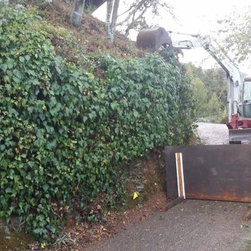
While our work on this property was more extensive, the story I tell here centers around the challenge of deciding how to improve a difficult driveway. After taking my class at the College of Marin, the client approached me to give them a price on extending a poured concrete wall along the driveway. The concrete concept was going to be expensive ($3070k) and would require permits and engineering. The bigger issue was that because the driveway was so narrow I didn’t think a wall right next to it would make drivers feel more comfortable than the existing ivy. When you are driving an expensive car a few inches away from a narrow concrete wall many people feel uneasy.
My first suggestion was to remove the ivy, grade the slope a little, and plant a hedge of Nandina (heavenly bamboo) at the bottom. This would be more attractive than the wall, harmless to cars, and deer-resistant. The client liked this idea. Because Nandina it is a slowgrowing plant, the plan was to bring in about seventy plants that were already 4’ tall, bringing the installed cost to around $18k.
Then the client brought up their interest in vertical gardens. Their thought was to put a vertical garden on a bare piece of concrete on the house. Aesthetically this was a great idea. However, using the prefabricated vertical garden sections they had found which cost $100 per 3’ section and another several hundred to plant each one it would be very expensive per square foot. It got me thinking that we could make a more extensive and useful vertical garden on the newly graded driveway slope for much less per square foot.
My goal was to save the client money by getting rid of the prefabricated sections of vertical garden at $100 each and use the rocky slope itself as a material to chip out planting holes in the rock. With that in mind, I gave a fixed price that included:
-Grading and removing 40 yards of rock and ivy to soften the driveway slope: $10k. We capped it at 40 yards because anything more would have triggered a grading per mit with Mill Valley which, in turn, would have triggered engineering reports that would have tripled the cost and the has sle. As long as we are improving the safety and stability of what has been there for more than 50 years, I prefer to avoid en gineers who are required to recommend costly upgrades to get insurance. I used the machine I had bought for my Scottish client to do the grading.
-Buying and planting 700 4” plants for the cliff face and irrigating them: $12k. This reflected the fact that planting would occur on a cliff and that each planting hole would be chipped out of fractious rock.
If all went well, we would have a dramatically enhanced slope with a softer vertical garden for about half the cost of the original concrete wall. The client would get a bigger vertical garden and cars would not be driving close to a hard wall. But, while I had given a flat cost to do this project, it was not at all clear that things would go as planned. About 5% of what I do are things I have never seen done before so I need to make educated guesses and make contingency plans.
When the grading was done, I tested the slope to see how our plan of digging holes in the rock face would work. Tying a climbing rope to the deck posts, we descended with crowbars and hammer drills to the slope face and did a few test holes. The vibrations from making the holes created little slides as surrounding rock broke free; it was clear that this approach would not work.
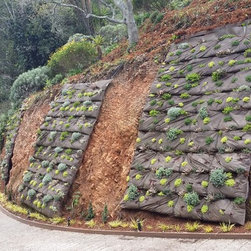
I had four contingency plans in place, knowing that nothing about this project would be predictable. I ended up needing all four of them. My fourth contingency plan was to use galvanized fencing as an armature that was anchored at the top of the slope using 3-5’ metal stakes and nylon cables. To this I stapled pressure-treated 2’x4’s to create a backdrop to which I could staple polyester fabric, which I then painted so we would not have to look at the ugly gray color until plants filled in. Polyester was important because it is UV resistant and tough. Fortunately, I could get 300’ rolls of it at a reasonable price.
If I had used the prefabricated vertical garden sections the client had researched just the infrastructure would have cost $20k. I was not happy about the fact that in the prefab design, the soil pockets were only about 4” in diameter.
This seemed like a poor long-term fit for plants. Anyone who has tried to sustain house plants in 4” pots for very long knows that the plants get root bound and stressed because there is not much stored fertilizer in such a small pocket of soil. The custom planter pockets I built gave at least 1’ of soil per plant.
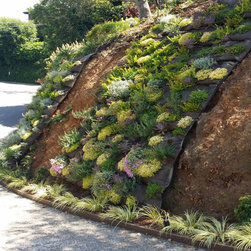
The client and I agreed to do three vertical sections of hanging gardens in rectangles and then plant creeping figs in between. This was partly a compromise between the couple. One member liked the creeping figs more and one liked the vertical garden more. It worked. The planters that you see here are less expensive than the prefabricated models on the market while giving plants much more soil to grow in. Attached to a galvanized armature of fencing, they also add a stabilizing weight that discourages slides and stops stray rocks from falling down in those areas. The whole thing was possible without permits and for less money than a less attractive wall. As the creeping figs fill in the whole surface will become a living green wall. The photo below was done right after install.
http://www.mysticallandscapes.com/portfolio/#/vertical-garden/
My first suggestion was to remove the ivy, grade the slope a little, and plant a hedge of Nandina (heavenly bamboo) at the bottom. This would be more attractive than the wall, harmless to cars, and deer-resistant. The client liked this idea. Because Nandina it is a slowgrowing plant, the plan was to bring in about seventy plants that were already 4’ tall, bringing the installed cost to around $18k.
Then the client brought up their interest in vertical gardens. Their thought was to put a vertical garden on a bare piece of concrete on the house. Aesthetically this was a great idea. However, using the prefabricated vertical garden sections they had found which cost $100 per 3’ section and another several hundred to plant each one it would be very expensive per square foot. It got me thinking that we could make a more extensive and useful vertical garden on the newly graded driveway slope for much less per square foot.
My goal was to save the client money by getting rid of the prefabricated sections of vertical garden at $100 each and use the rocky slope itself as a material to chip out planting holes in the rock. With that in mind, I gave a fixed price that included:
-Grading and removing 40 yards of rock and ivy to soften the driveway slope: $10k. We capped it at 40 yards because anything more would have triggered a grading per mit with Mill Valley which, in turn, would have triggered engineering reports that would have tripled the cost and the has sle. As long as we are improving the safety and stability of what has been there for more than 50 years, I prefer to avoid en gineers who are required to recommend costly upgrades to get insurance. I used the machine I had bought for my Scottish client to do the grading.
-Buying and planting 700 4” plants for the cliff face and irrigating them: $12k. This reflected the fact that planting would occur on a cliff and that each planting hole would be chipped out of fractious rock.
If all went well, we would have a dramatically enhanced slope with a softer vertical garden for about half the cost of the original concrete wall. The client would get a bigger vertical garden and cars would not be driving close to a hard wall. But, while I had given a flat cost to do this project, it was not at all clear that things would go as planned. About 5% of what I do are things I have never seen done before so I need to make educated guesses and make contingency plans.
When the grading was done, I tested the slope to see how our plan of digging holes in the rock face would work. Tying a climbing rope to the deck posts, we descended with crowbars and hammer drills to the slope face and did a few test holes. The vibrations from making the holes created little slides as surrounding rock broke free; it was clear that this approach would not work.
I had four contingency plans in place, knowing that nothing about this project would be predictable. I ended up needing all four of them. My fourth contingency plan was to use galvanized fencing as an armature that was anchored at the top of the slope using 3-5’ metal stakes and nylon cables. To this I stapled pressure-treated 2’x4’s to create a backdrop to which I could staple polyester fabric, which I then painted so we would not have to look at the ugly gray color until plants filled in. Polyester was important because it is UV resistant and tough. Fortunately, I could get 300’ rolls of it at a reasonable price.
If I had used the prefabricated vertical garden sections the client had researched just the infrastructure would have cost $20k. I was not happy about the fact that in the prefab design, the soil pockets were only about 4” in diameter.
This seemed like a poor long-term fit for plants. Anyone who has tried to sustain house plants in 4” pots for very long knows that the plants get root bound and stressed because there is not much stored fertilizer in such a small pocket of soil. The custom planter pockets I built gave at least 1’ of soil per plant.
The client and I agreed to do three vertical sections of hanging gardens in rectangles and then plant creeping figs in between. This was partly a compromise between the couple. One member liked the creeping figs more and one liked the vertical garden more. It worked. The planters that you see here are less expensive than the prefabricated models on the market while giving plants much more soil to grow in. Attached to a galvanized armature of fencing, they also add a stabilizing weight that discourages slides and stops stray rocks from falling down in those areas. The whole thing was possible without permits and for less money than a less attractive wall. As the creeping figs fill in the whole surface will become a living green wall. The photo below was done right after install.
http://www.mysticallandscapes.com/portfolio/#/vertical-garden/