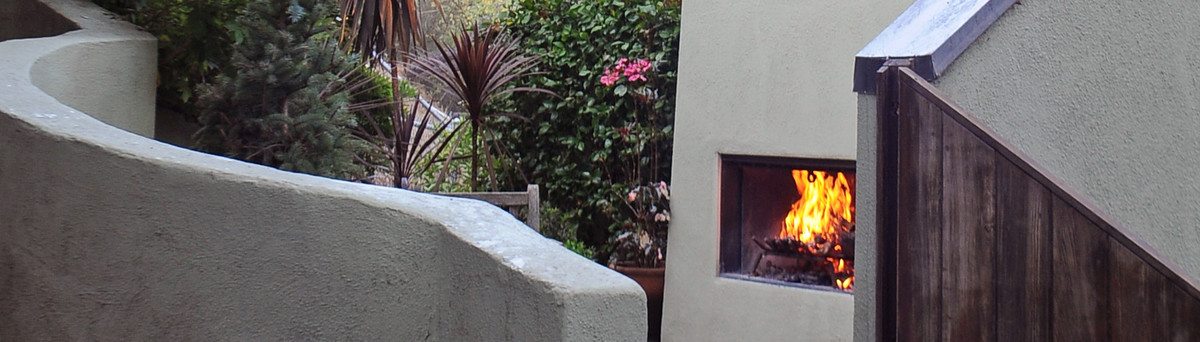

House in Benedict Canyon
Stratifying:
Los Angeles, California
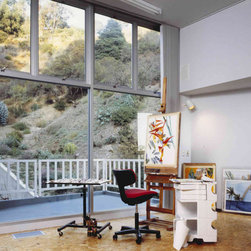
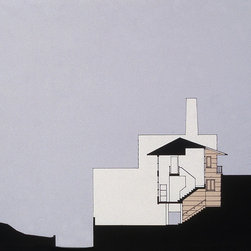
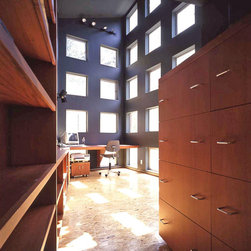
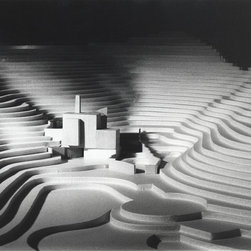
The site is the steep slope of a beautiful, secluded canyon overlooking the city. Passed-over for reasons of design and construction difficulty, this tricky site proved to be worth the trouble. Grading requirements for an on-site debris basin and the presence of soft, alluvial soil pushed the house back into solid rock and upward to three storeys. The blind uphill elevation that results is countered by an open plan with cantilevered concrete floors and expansive fenestration on the downhill side. Striking views are reinforced - the nighttime lights of the city from the living room and master bedroom and a sweeping prospect of the canyon from the dining room, study, and studio.
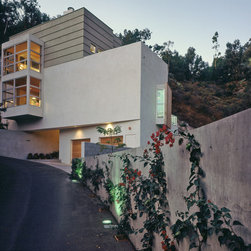
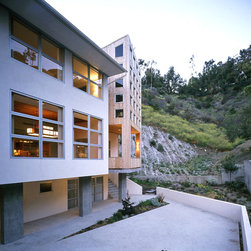
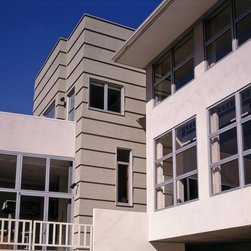
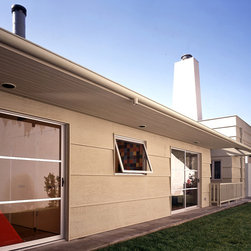
Formally, the house finds a compositional middle route between sculptural fragmentation (think Frank Gehry) and the unified envelope of the traditional American house (think Charles Moore). The hybrid allows multiple images of house - the elevations of this house are surprisingly different - each responding differently to its part of the site. The two-story garage / studio wing stretches the front into a protective portal. A raised terrace, framed by an assemblage of volumes, becomes center stage. Third floor bedrooms open under deep eaves like a single story ranch house down in the flats.
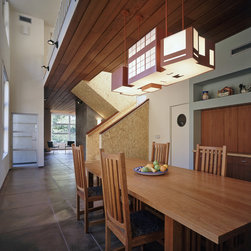
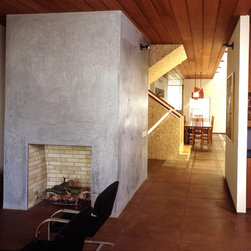
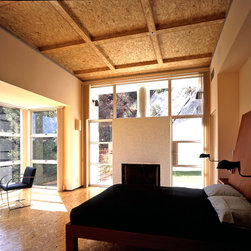
The composition is anchored by notation. Changes in materials structure spaces horizontally and mark vertical connections between the layers. The natural colors and textures of finish materials are emphasized by using big reveals and flush detailing to make walls, floors, and ceilings read as separate, discontinuous planes. Stained concrete steps rise through a glass-canopied shaft and turn to enter the main floor gallery space that is both entry hall and dining room. A staircase boxed in ordinary strandboard sheathing, scissors up a glazed stairwell where you can sense the downward sweep of the hillside above the house. The light fixture over the dining table is a miniature representation of the volume you are sitting in when you see it.
Los Angeles, California
The site is the steep slope of a beautiful, secluded canyon overlooking the city. Passed-over for reasons of design and construction difficulty, this tricky site proved to be worth the trouble. Grading requirements for an on-site debris basin and the presence of soft, alluvial soil pushed the house back into solid rock and upward to three storeys. The blind uphill elevation that results is countered by an open plan with cantilevered concrete floors and expansive fenestration on the downhill side. Striking views are reinforced - the nighttime lights of the city from the living room and master bedroom and a sweeping prospect of the canyon from the dining room, study, and studio.
Formally, the house finds a compositional middle route between sculptural fragmentation (think Frank Gehry) and the unified envelope of the traditional American house (think Charles Moore). The hybrid allows multiple images of house - the elevations of this house are surprisingly different - each responding differently to its part of the site. The two-story garage / studio wing stretches the front into a protective portal. A raised terrace, framed by an assemblage of volumes, becomes center stage. Third floor bedrooms open under deep eaves like a single story ranch house down in the flats.
The composition is anchored by notation. Changes in materials structure spaces horizontally and mark vertical connections between the layers. The natural colors and textures of finish materials are emphasized by using big reveals and flush detailing to make walls, floors, and ceilings read as separate, discontinuous planes. Stained concrete steps rise through a glass-canopied shaft and turn to enter the main floor gallery space that is both entry hall and dining room. A staircase boxed in ordinary strandboard sheathing, scissors up a glazed stairwell where you can sense the downward sweep of the hillside above the house. The light fixture over the dining table is a miniature representation of the volume you are sitting in when you see it.