
River House
A House at the Meeting of Two Landscapes,
Osage County, Missouri
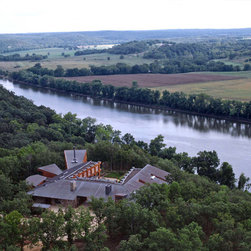
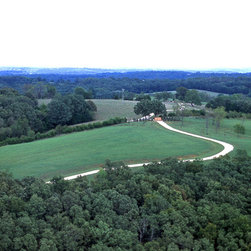
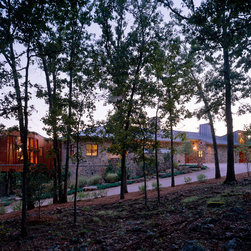
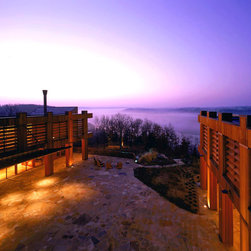
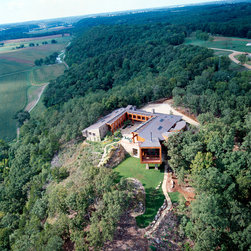
Set on a bluff overlooking the Osage River and bordered on three side by forest, this family vacation compound in the Ozarks begins transformation of a thousand-acre working farm into a retreat facility and ecological study center. Starting high on the property, a half-mile entry drive gives no hint of the house before it dives into the woods and ends abruptly at a central portal with a cross-river view.
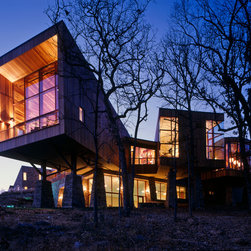
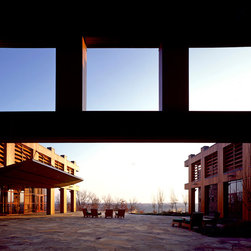
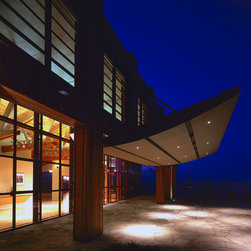
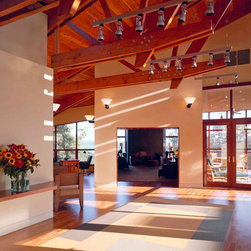
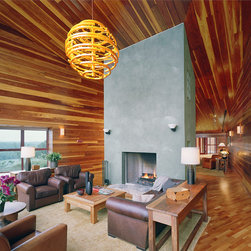
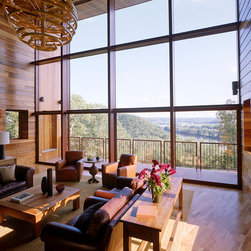
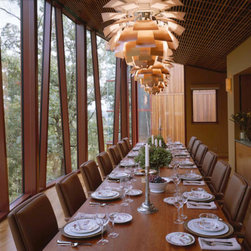
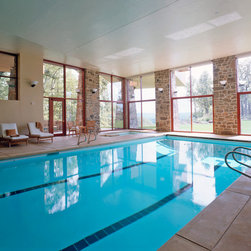
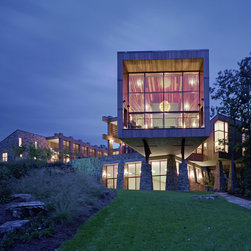
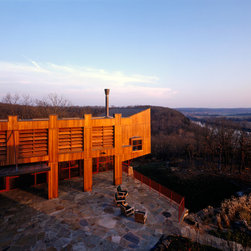
The plan is a frame. Clusters of rooms are organized around a central court, itself defining a niche in the larger landscape.Seen as an active, socializing space, the court accommodates casual use as well as formal events that sometimes use the entry canopy as an acoustical shell. Passage between living apartments on the west and the bigger rooms on the east is through the court for much of the year. The relationships between these communal spaces and the outside change from room to room. The living room projects axially along a clearing to take in a bend in the river. The curving window of the dining room presses against the forest, its mullions tilting like the tree trunks beyond. Foundation walls drop off the bluff to enclose a swimming pool two levels below.
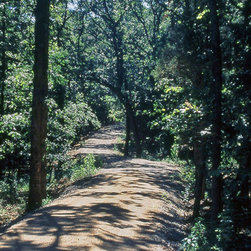
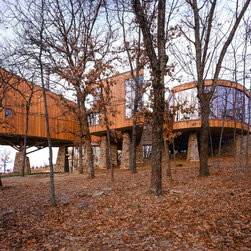
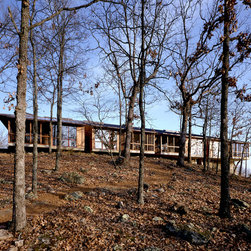
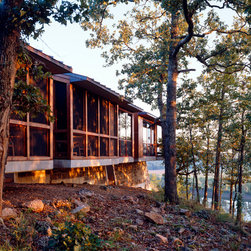
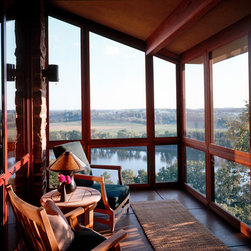
On the west, walkways slice through a range of two-story suites to give private access to a network of trails. Sitting rooms and screened porches cantilever over the forest floor to soften the building’s impact. View corridors through the forest are maintained to give selected vistas and interior spaces merge with the understory.
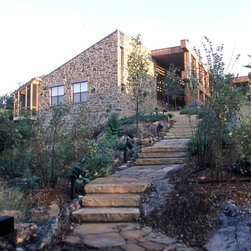
Rural sites require self-sufficiency. True North - South orientation and embedment of lower levels in natural rock reduce energy requirements. The louvered courtyard arcade works with interior shades to minimize summer heat gain. Thermally broken metal window frames and insulating glass minimize heat transfer. Heating and cooling are provided by a groundsource geothermal system that transfers constant ground water temperature to heat pumps in attic spaces. Space heating efficiently combines radiant slabs and forced-air. Attic fans assist natural ventilation and ceiling fans keep rooms comfortable. Exterior materials – local fieldstone, wood siding, copper roofing - were selected for durability and natural finish.
Design Awards:
Building Stone Institute: Tucker Award, Chicago, 2004
AIA / St. Louis, St. Louis, 2002;
Chicago Athenaeum, American Architecture Award, Chicago, 2002.
Publication:
100x: Architects of the Americas, Braun, Switzerland, 2008
Dream Houses L.A., Panache, 2008
Images, (Australia), 2006
Loft Publications (Barcelona) 2005
Colorfulness (Beijing), June, 2004
Western Interiors and Design, November, 2003
Places, A Forum of Environmental Design, Vol.14, No.3, 2002
Interior Digest (Moskow), October, 2002
Arkinetia internet, (Madrid), 2006
TV: The Travel Channel, Mathis Productions, 2004
Osage County, Missouri
Set on a bluff overlooking the Osage River and bordered on three side by forest, this family vacation compound in the Ozarks begins transformation of a thousand-acre working farm into a retreat facility and ecological study center. Starting high on the property, a half-mile entry drive gives no hint of the house before it dives into the woods and ends abruptly at a central portal with a cross-river view.
The plan is a frame. Clusters of rooms are organized around a central court, itself defining a niche in the larger landscape.Seen as an active, socializing space, the court accommodates casual use as well as formal events that sometimes use the entry canopy as an acoustical shell. Passage between living apartments on the west and the bigger rooms on the east is through the court for much of the year. The relationships between these communal spaces and the outside change from room to room. The living room projects axially along a clearing to take in a bend in the river. The curving window of the dining room presses against the forest, its mullions tilting like the tree trunks beyond. Foundation walls drop off the bluff to enclose a swimming pool two levels below.
On the west, walkways slice through a range of two-story suites to give private access to a network of trails. Sitting rooms and screened porches cantilever over the forest floor to soften the building’s impact. View corridors through the forest are maintained to give selected vistas and interior spaces merge with the understory.
Rural sites require self-sufficiency. True North - South orientation and embedment of lower levels in natural rock reduce energy requirements. The louvered courtyard arcade works with interior shades to minimize summer heat gain. Thermally broken metal window frames and insulating glass minimize heat transfer. Heating and cooling are provided by a groundsource geothermal system that transfers constant ground water temperature to heat pumps in attic spaces. Space heating efficiently combines radiant slabs and forced-air. Attic fans assist natural ventilation and ceiling fans keep rooms comfortable. Exterior materials – local fieldstone, wood siding, copper roofing - were selected for durability and natural finish.
Design Awards:
Building Stone Institute: Tucker Award, Chicago, 2004
AIA / St. Louis, St. Louis, 2002;
Chicago Athenaeum, American Architecture Award, Chicago, 2002.
Publication:
100x: Architects of the Americas, Braun, Switzerland, 2008
Dream Houses L.A., Panache, 2008
Images, (Australia), 2006
Loft Publications (Barcelona) 2005
Colorfulness (Beijing), June, 2004
Western Interiors and Design, November, 2003
Places, A Forum of Environmental Design, Vol.14, No.3, 2002
Interior Digest (Moskow), October, 2002
Arkinetia internet, (Madrid), 2006
TV: The Travel Channel, Mathis Productions, 2004
Project Year: 2005
Project Cost: More than $2,000,000
Country: United States
Zip Code: 65085