

Pima Canyon
A desert retreat that feels like it has always been there.
When a custom home takes shape at the edge of protected wilderness, the landscape has to do more than look beautiful—it has to belong. That was the challenge Elizabeth Przygoda, of Boxhill Design, faced when she was invited to design the grounds for this architectural estate in Tucson’s Pima Canyon. Working in close collaboration with architect Ron Robinette and Cimarron Circle Construction, she set out to create a landscape that respected its fragile context, embraced bold architectural features, and elevated the homeowners’ experience of desert living.
Designing with the Desert
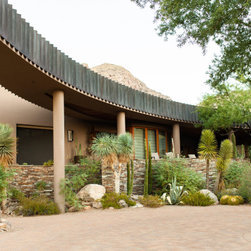
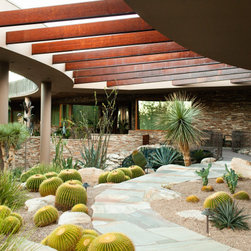
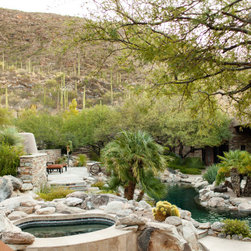
The Santa Catalina Mountains became both muse and material source. Elizabeth layered palo verde, mesquite, ocotillo, and massed golden and red barrel cactus in sweeping, sculptural groupings, echoing the natural rhythms of the desert. Boulder landscaping, sourced locally, anchored the design, while decomposed granite in Desert Gold seamlessly tied the property back to the surrounding terrain.
A Natural-Style Pool That Disappears into the Landscape
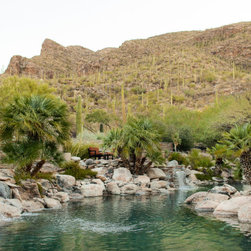
At the heart of the backyard is a naturalistic pool and spa, faced with native stone and softened with rock waterfalls and desert tropical plantings. The result is a backyard oasis that feels carved from the canyon itself—a resort-style retreat that balances luxury with restraint.
Blending Architecture and Landscape
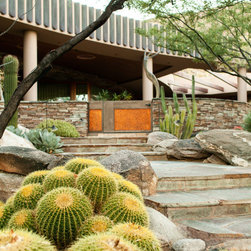
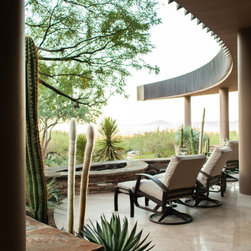
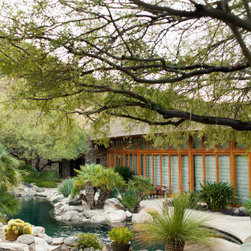
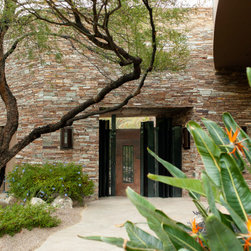
Elizabeth’s design amplifies the home’s architectural features. Custom steel gates, rusted pergola beams, and two beehive fireplaces create moments of connection between indoors and out. Shaded patios lined with lounge seating and large pottery planters invite relaxation while framing panoramic mountain views.
Privacy Without Compromise
With a public trail bordering the property, privacy was paramount—but obstructing the breathtaking views wasn’t an option. Elizabeth’s solution: a “cactus fence”—densely planted cacti forming a natural, living barrier—paired with clear fencing and a buried snake fence for security. This approach preserved sightlines, encouraged wildlife passage, and upheld the home’s seamless relationship to the canyon.
Sustainability with Longevity in Mind
Every detail was designed for endurance. Drip irrigation helped establish the planting palette before the landscape was weaned off supplemental water, and a passive water management system redirected overflow into subgrade planting beds. In 2020, Elizabeth revisited the project, replacing outdated grasses with desert-adapted cacti—a subtle yet significant update that aligned the design with modern ecological standards.
A Lasting Collaboration
Nearly two decades later, Pima Canyon Estate stands as a testament to collaborative design—a project where architectural boldness, ecological sensitivity, and client vision came together to create a space that evolves beautifully with time.
When a custom home takes shape at the edge of protected wilderness, the landscape has to do more than look beautiful—it has to belong. That was the challenge Elizabeth Przygoda, of Boxhill Design, faced when she was invited to design the grounds for this architectural estate in Tucson’s Pima Canyon. Working in close collaboration with architect Ron Robinette and Cimarron Circle Construction, she set out to create a landscape that respected its fragile context, embraced bold architectural features, and elevated the homeowners’ experience of desert living.
Designing with the Desert
The Santa Catalina Mountains became both muse and material source. Elizabeth layered palo verde, mesquite, ocotillo, and massed golden and red barrel cactus in sweeping, sculptural groupings, echoing the natural rhythms of the desert. Boulder landscaping, sourced locally, anchored the design, while decomposed granite in Desert Gold seamlessly tied the property back to the surrounding terrain.
A Natural-Style Pool That Disappears into the Landscape
At the heart of the backyard is a naturalistic pool and spa, faced with native stone and softened with rock waterfalls and desert tropical plantings. The result is a backyard oasis that feels carved from the canyon itself—a resort-style retreat that balances luxury with restraint.
Blending Architecture and Landscape
Elizabeth’s design amplifies the home’s architectural features. Custom steel gates, rusted pergola beams, and two beehive fireplaces create moments of connection between indoors and out. Shaded patios lined with lounge seating and large pottery planters invite relaxation while framing panoramic mountain views.
Privacy Without Compromise
With a public trail bordering the property, privacy was paramount—but obstructing the breathtaking views wasn’t an option. Elizabeth’s solution: a “cactus fence”—densely planted cacti forming a natural, living barrier—paired with clear fencing and a buried snake fence for security. This approach preserved sightlines, encouraged wildlife passage, and upheld the home’s seamless relationship to the canyon.
Sustainability with Longevity in Mind
Every detail was designed for endurance. Drip irrigation helped establish the planting palette before the landscape was weaned off supplemental water, and a passive water management system redirected overflow into subgrade planting beds. In 2020, Elizabeth revisited the project, replacing outdated grasses with desert-adapted cacti—a subtle yet significant update that aligned the design with modern ecological standards.
A Lasting Collaboration
Nearly two decades later, Pima Canyon Estate stands as a testament to collaborative design—a project where architectural boldness, ecological sensitivity, and client vision came together to create a space that evolves beautifully with time.
Project Year: 2020
Project Cost: $150,001 - $200,000