
Split Personalities
Split Personalities
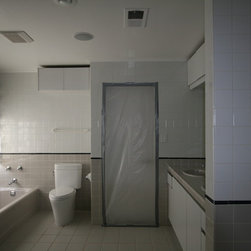
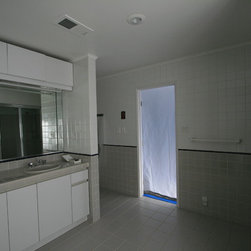
Two second-floor guest bedrooms shared a “Jack-n-Jill” bathroom. With frequent out-of-town guests, awkward encounters ensued. A decision was made to split the bathroom in two, creating an on-suite bathroom for each bedroom.
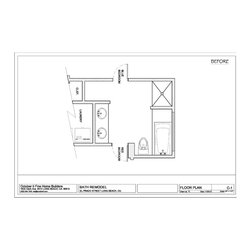
The “Jack-n-Jill” bathroom wasn’t tremendously large, so every square foot counted. Both bathrooms required the typical components; toilet, vanity, shower and storage. A large window could not be removed or relocated as it aligned with the window below, one bedroom bath required a soaking tub in addition to the shower, and the construction time-line was limited to 3 months.
If these constraints weren’t sufficient, the homeowner’s maintained an impressive art collection, so dust was to remain non-existent!
Designing an efficient floor plan was comparable to solving the 3-D combination puzzle invented in 1974 by Hungarian sculptor and professor of architecture Ernő Rubik - Rubix’s Cube.
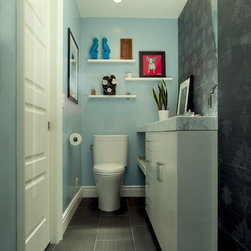
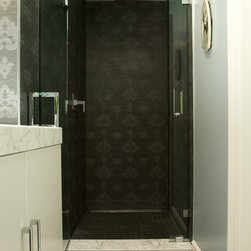
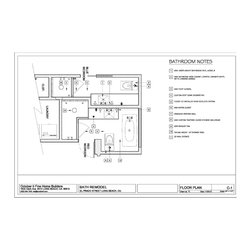
The blue-bedroom bath was limited to 51” in width due to the restrictions of the existing window, which remained in the other bathroom. A solar-powered roof window was installed to provide natural light and ventilation. The shower stall fit snugly into an existing 3’ x 3’ alcove.
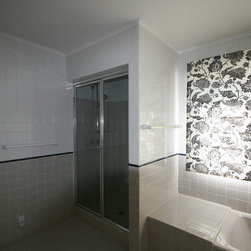
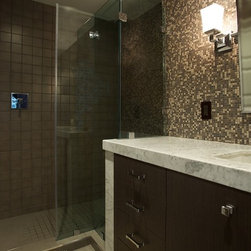
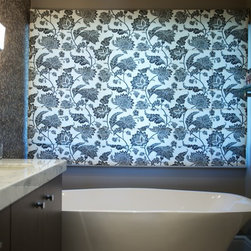
The red-bedroom bath was allocated the remaining 78”of width but also required a soaking tub in addition to the walk-in shower. The existing window provide natural light and ventilation. The project underscores our theory of small spaces;
1. Reduce, reduce, reduce – materials, lines and textures.
2. Outside corners provide a greater sense of depth.
3. Contrast limited materials yet harmonize colors.
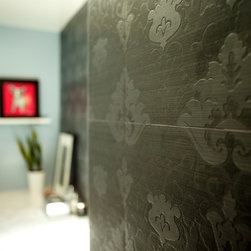
One final note – the client eager to show off the project, held an open house/special reveal party for neighbors, family and friends. One visitor approached the homeowner and asked, “Why would you put wallpaper in the shower?” Puzzled by the question, he replied, “I don’t know? Why would you?” The visitor stated, “You put wallpaper in the blue bathroom!” He smiled and let her know is was tile . . . she ran back upstairs.
Two second-floor guest bedrooms shared a “Jack-n-Jill” bathroom. With frequent out-of-town guests, awkward encounters ensued. A decision was made to split the bathroom in two, creating an on-suite bathroom for each bedroom.
The “Jack-n-Jill” bathroom wasn’t tremendously large, so every square foot counted. Both bathrooms required the typical components; toilet, vanity, shower and storage. A large window could not be removed or relocated as it aligned with the window below, one bedroom bath required a soaking tub in addition to the shower, and the construction time-line was limited to 3 months.
If these constraints weren’t sufficient, the homeowner’s maintained an impressive art collection, so dust was to remain non-existent!
Designing an efficient floor plan was comparable to solving the 3-D combination puzzle invented in 1974 by Hungarian sculptor and professor of architecture Ernő Rubik - Rubix’s Cube.
The blue-bedroom bath was limited to 51” in width due to the restrictions of the existing window, which remained in the other bathroom. A solar-powered roof window was installed to provide natural light and ventilation. The shower stall fit snugly into an existing 3’ x 3’ alcove.
The red-bedroom bath was allocated the remaining 78”of width but also required a soaking tub in addition to the walk-in shower. The existing window provide natural light and ventilation. The project underscores our theory of small spaces;
1. Reduce, reduce, reduce – materials, lines and textures.
2. Outside corners provide a greater sense of depth.
3. Contrast limited materials yet harmonize colors.
One final note – the client eager to show off the project, held an open house/special reveal party for neighbors, family and friends. One visitor approached the homeowner and asked, “Why would you put wallpaper in the shower?” Puzzled by the question, he replied, “I don’t know? Why would you?” The visitor stated, “You put wallpaper in the blue bathroom!” He smiled and let her know is was tile . . . she ran back upstairs.
Project Year: 2012
Project Cost: $50,001 - $75,000
Country: United States
Zip Code: 90815