
Far Pond
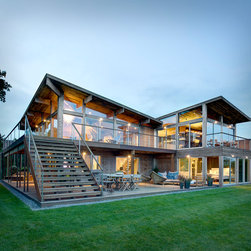
The waterfront site of an existing 1970’s kit house overlooks layers of
wetlands to an estuary, the bay, and the ocean. The client set the
parameters of keeping the existing structure while doubling the size of the
house with an addition. The existing structure consists of glulam post and
beam construction connected with steel plates. One solution could be to
mimic the existing architectural language of the post and beam skeletal
structure in the addition. Since the existing house clearly expressed the
structural system, the addition should also express this. The architect
chose to clearly identify the existing system of the house and create a
dialogue with a contrasting panelized system in the addition. The new
system utilizes prefabricated elements that resolve multiple structural and
spatial problems. Examining the strategy of a kit of parts, current
material fabrication technologies are utilized to expand on this idea. A
different approach to sustainability is explored, minimizing waste by
simplifying to the essential components in order to resolve multiple
problems, thus eliminating typical construction waste. Using a standard as
a precedent and developing a new structural system paired with the latest
technologies, a material can accomplish multiple tasks and heighten the
experience of inhabiting the space.
Prefabricated shear wall panels, used in light frame construction in areas
that are hurricane prone with high force winds, were studied. Most are
made from a light gauge metal folded to add strength and rigidity. For our
case the panels were to be exposed and used for more than just a hidden
structural component. A standard light gauge 4x8 steel sheet was folded
back and forth along the long axis adding the same strength and rigidity to
the panel. The resulting 2’ panel locks into adjacent panels and is a
structural shear and bearing assembly, as well as a decorative furniture
component.
The new structural panels multitask throughout the addition. The solid
steel transitions to a perforated panel that baffles the sunlight over
windows and doors. The light quality varies throughout the day as light
levels transition through the overlapped perforations. Fins that protrude
from the wall panels are laser cut to accept shelving, seating and
countertops. The same perforated steel becomes the dining room chandelier,
and the platform for the stair and desk. This one material is exhausted in
its possible uses throughout the house, minimizing the necessity for
additional components that require wasteful shipping and packaging. The
secondary infill material is used through both structures, on the floors,
walls and ceilings to unify the old and the new.
Using new technologies to fabricate customized panels from a standard
product accomplishes several things: less material is necessary to achieve
greater structural strength, multiple programs can be integrated into one
material, waste is minimized resulting in a more effective approach to
sustainability, and the dialogue between the existing and new structural
systems elevates the experience of inhabiting the space.
wetlands to an estuary, the bay, and the ocean. The client set the
parameters of keeping the existing structure while doubling the size of the
house with an addition. The existing structure consists of glulam post and
beam construction connected with steel plates. One solution could be to
mimic the existing architectural language of the post and beam skeletal
structure in the addition. Since the existing house clearly expressed the
structural system, the addition should also express this. The architect
chose to clearly identify the existing system of the house and create a
dialogue with a contrasting panelized system in the addition. The new
system utilizes prefabricated elements that resolve multiple structural and
spatial problems. Examining the strategy of a kit of parts, current
material fabrication technologies are utilized to expand on this idea. A
different approach to sustainability is explored, minimizing waste by
simplifying to the essential components in order to resolve multiple
problems, thus eliminating typical construction waste. Using a standard as
a precedent and developing a new structural system paired with the latest
technologies, a material can accomplish multiple tasks and heighten the
experience of inhabiting the space.
Prefabricated shear wall panels, used in light frame construction in areas
that are hurricane prone with high force winds, were studied. Most are
made from a light gauge metal folded to add strength and rigidity. For our
case the panels were to be exposed and used for more than just a hidden
structural component. A standard light gauge 4x8 steel sheet was folded
back and forth along the long axis adding the same strength and rigidity to
the panel. The resulting 2’ panel locks into adjacent panels and is a
structural shear and bearing assembly, as well as a decorative furniture
component.
The new structural panels multitask throughout the addition. The solid
steel transitions to a perforated panel that baffles the sunlight over
windows and doors. The light quality varies throughout the day as light
levels transition through the overlapped perforations. Fins that protrude
from the wall panels are laser cut to accept shelving, seating and
countertops. The same perforated steel becomes the dining room chandelier,
and the platform for the stair and desk. This one material is exhausted in
its possible uses throughout the house, minimizing the necessity for
additional components that require wasteful shipping and packaging. The
secondary infill material is used through both structures, on the floors,
walls and ceilings to unify the old and the new.
Using new technologies to fabricate customized panels from a standard
product accomplishes several things: less material is necessary to achieve
greater structural strength, multiple programs can be integrated into one
material, waste is minimized resulting in a more effective approach to
sustainability, and the dialogue between the existing and new structural
systems elevates the experience of inhabiting the space.
Country: United States