

Island Cottage
This small 1930s waterman's cottage is located on Saint George Island, a low-lying, tidewater island, situated at the confluence of the Potomac River with the Saint Mary's River near Chesapeake Bay in Saint Mary's County, Maryland. Sited on the southwestern side of the island, this house had been compromised through a series of expeditious "improvements."
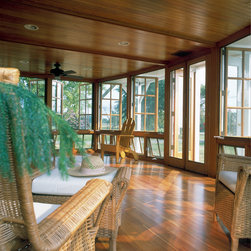
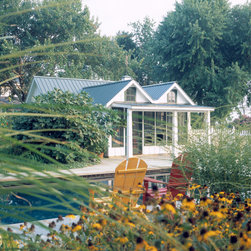
With spectacular westerly sunsets over the broad tidal Potomac River, the clients desired to replace a falling-down screened porch with a new, enclosed porch and roof deck that would capture the panoramic views. One of the primary goals was to design the new porch in such a way that it could be easily converted from and enclosed space to a screened porch or back at a moments notice. Thus eliminating the ubiquitous "pain-in-the-ass" necessity of having to seasonally change and alternately store screen and glass panels.
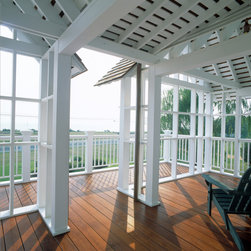
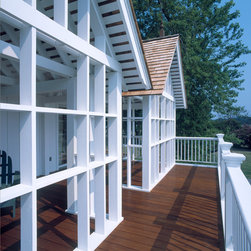
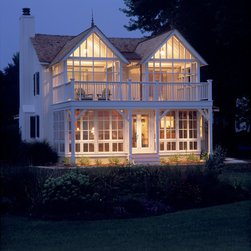
Upon initial study, it was proposed that with marginal additional effort, the new porch offered an opportunity to substantially improve the overall aesthetics of the house while providing a unique architectural expression appropriate to the relaxed island environment. Although thoroughly contemporary in conception, the design expresses the vocabulary of the simple vertical board-and-batten buildings that recall the island's architectural past. The open framing of the upper porches was conceived of as "battens without boards" and continues the pattern of vertical battens in the framing and window muntins below.
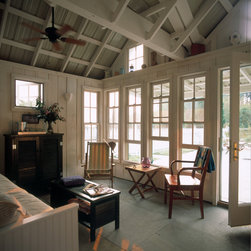
To fully engage the panoramic views, the enclosed porch was designed as a convex wall of casement windows. When completely open, the French casement windows virtually disappear from the primary view angles inside the porch. The upper-level open porches overhang the south-facing glass providing solar shading and allowing these windows to remain open and protected in a summer rain.
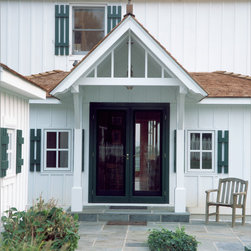
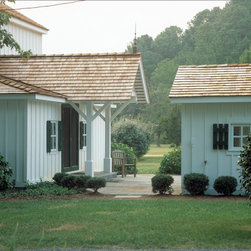
In addition to the porch, the project also included re-siding the house with vertical board and batten, the addition of a new entry stoop, a swimming pool, and a pool cabana. Although the pool cabana was designed in a much simpler mode as an outbuilding, its double gables reflect the new form of the main house. By similar design and axial relationships, the new additions serve to link the existing estranged buildings, creating a casual but cohesive compound of structures
With spectacular westerly sunsets over the broad tidal Potomac River, the clients desired to replace a falling-down screened porch with a new, enclosed porch and roof deck that would capture the panoramic views. One of the primary goals was to design the new porch in such a way that it could be easily converted from and enclosed space to a screened porch or back at a moments notice. Thus eliminating the ubiquitous "pain-in-the-ass" necessity of having to seasonally change and alternately store screen and glass panels.
Upon initial study, it was proposed that with marginal additional effort, the new porch offered an opportunity to substantially improve the overall aesthetics of the house while providing a unique architectural expression appropriate to the relaxed island environment. Although thoroughly contemporary in conception, the design expresses the vocabulary of the simple vertical board-and-batten buildings that recall the island's architectural past. The open framing of the upper porches was conceived of as "battens without boards" and continues the pattern of vertical battens in the framing and window muntins below.
To fully engage the panoramic views, the enclosed porch was designed as a convex wall of casement windows. When completely open, the French casement windows virtually disappear from the primary view angles inside the porch. The upper-level open porches overhang the south-facing glass providing solar shading and allowing these windows to remain open and protected in a summer rain.
In addition to the porch, the project also included re-siding the house with vertical board and batten, the addition of a new entry stoop, a swimming pool, and a pool cabana. Although the pool cabana was designed in a much simpler mode as an outbuilding, its double gables reflect the new form of the main house. By similar design and axial relationships, the new additions serve to link the existing estranged buildings, creating a casual but cohesive compound of structures
Country: United States