
Greenwich Country House
The expansive country house in the depths of Old Greenwich combines aesthetic idioms in both its furniture and architecture. Although the room contains pieces in a variety of traditional styles, the overall feeling is informed by more modern ideas about space. Here, a light, bright airiness replaces a heavy traditional motifs.
The Neoclassical inspiration behind the decoration of the study / library is the French Bee. Designed as a cosy retreat, the room features a fainting sofa, swathed in petite flour-de-lis. On the floor is an antique Doris Leslie Blau Aubusson carpet of the Empire period, circa 1815. Opposite the sofa is a reproduction satinwood "Carlton House" desk with handprinted decoration. Before it sits a classic slipper chair upholstered in a striped Scalamandre yellow and white silk stripe. Also present is an antique George III oval satinwood work table and a commode inlaid with tulipwood decoration.
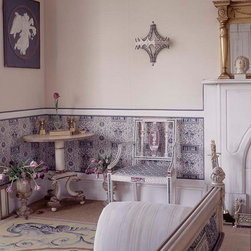
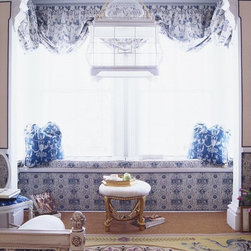
The sitting room displays a variety of painted and fabric finishes in a palette of white and yellow. All of the wood trim is given a faux marble treatment. Just as the upper walls and ceiling are painted in matching tones, the white of the lower walls is carried onto the painted floor, giving the room a bright and sunny feeling. Handprinted gold leaf bees dapple the floor and the wall near the dormer window. The window itself is framed by a drapery treatment, which features a triangulated pelmet tipped with gold leaf bells, made by Scalamandre. The window seat is covered with a Federal style fabric with pale yellow stripes.
Artwork in the room complements its furnishings. Two prints in fruitwood and marquetry frames are colored engravings by George Stubbs.
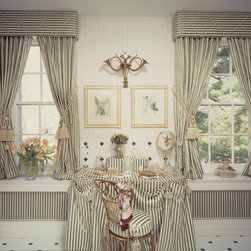
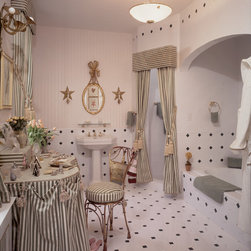
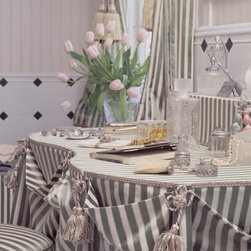
Combining traditional and modern design concepts to create spacious, airy interiors with a historical connection, this aspect is evident in the creation of this Greenwich Master Bath. The fabrics and materials selected are classic and timeless. Landscape is reflection by the selection of an Italian ceramic tile laid in a variety of shapes land patterns inspired by formal gardens. The matching green and white stripe fabric is a Regency pattern that is used throughout the room for a variety of purposes, creating a sense of harmony. For the window treatments, the stripes are hung vertically as drapes with a contrasting horizontal pattern valence. Stars, tassels, and swags appear in the room, recreating a sense of historical relativism. The artwork features authentic 19th Century botanical aquatints.
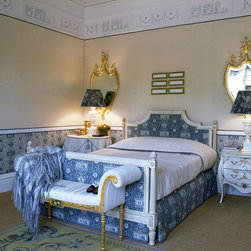
The Master Bedroom is inspired by the famed humanist architect Robert Adam. While an 18th Century icon, he is really a modernist in the simplicity and streamlined approach to design. In addition, his love of how "man" relates to his surroundings is exemplified in the detailing of his spaces, reiterated here in this Connecticut Master Bedroom.
In this expansive space, one is made to feel comfortable through a series of clever design devices. Bringing the height of the ceiling down, not feeling overwhelmed by the size of the space, creating cosy, warm places in which to read and see outside are all decorating and architectural features.
The Neoclassical inspiration behind the decoration of the study / library is the French Bee. Designed as a cosy retreat, the room features a fainting sofa, swathed in petite flour-de-lis. On the floor is an antique Doris Leslie Blau Aubusson carpet of the Empire period, circa 1815. Opposite the sofa is a reproduction satinwood "Carlton House" desk with handprinted decoration. Before it sits a classic slipper chair upholstered in a striped Scalamandre yellow and white silk stripe. Also present is an antique George III oval satinwood work table and a commode inlaid with tulipwood decoration.
The sitting room displays a variety of painted and fabric finishes in a palette of white and yellow. All of the wood trim is given a faux marble treatment. Just as the upper walls and ceiling are painted in matching tones, the white of the lower walls is carried onto the painted floor, giving the room a bright and sunny feeling. Handprinted gold leaf bees dapple the floor and the wall near the dormer window. The window itself is framed by a drapery treatment, which features a triangulated pelmet tipped with gold leaf bells, made by Scalamandre. The window seat is covered with a Federal style fabric with pale yellow stripes.
Artwork in the room complements its furnishings. Two prints in fruitwood and marquetry frames are colored engravings by George Stubbs.
Combining traditional and modern design concepts to create spacious, airy interiors with a historical connection, this aspect is evident in the creation of this Greenwich Master Bath. The fabrics and materials selected are classic and timeless. Landscape is reflection by the selection of an Italian ceramic tile laid in a variety of shapes land patterns inspired by formal gardens. The matching green and white stripe fabric is a Regency pattern that is used throughout the room for a variety of purposes, creating a sense of harmony. For the window treatments, the stripes are hung vertically as drapes with a contrasting horizontal pattern valence. Stars, tassels, and swags appear in the room, recreating a sense of historical relativism. The artwork features authentic 19th Century botanical aquatints.
The Master Bedroom is inspired by the famed humanist architect Robert Adam. While an 18th Century icon, he is really a modernist in the simplicity and streamlined approach to design. In addition, his love of how "man" relates to his surroundings is exemplified in the detailing of his spaces, reiterated here in this Connecticut Master Bedroom.
In this expansive space, one is made to feel comfortable through a series of clever design devices. Bringing the height of the ceiling down, not feeling overwhelmed by the size of the space, creating cosy, warm places in which to read and see outside are all decorating and architectural features.
Project Year: Pre-2005
Project Cost: $200,001 - $500,000
Country: United States
Zip Code: 06890