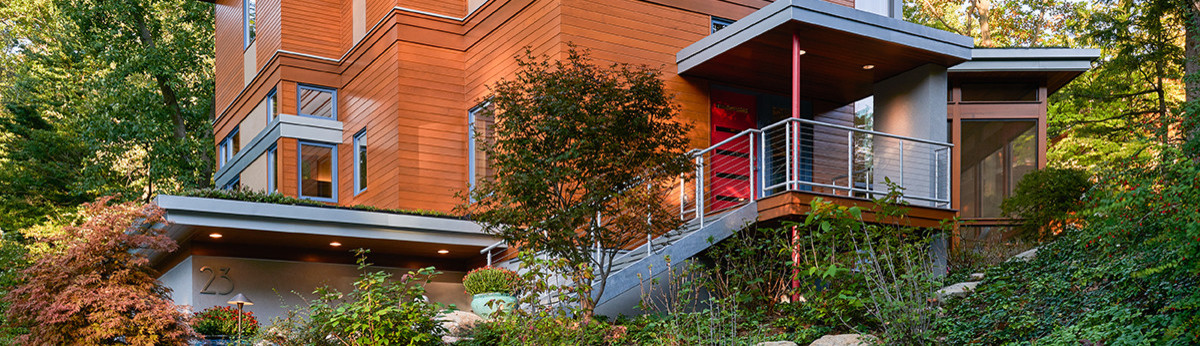

The Nautilus House
A Unique Vision, a Powerful Team, an Inspiring Home
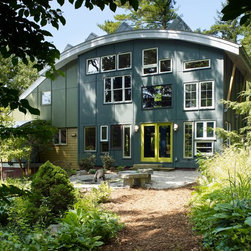
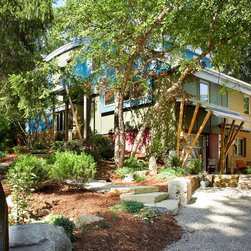
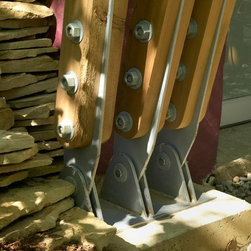
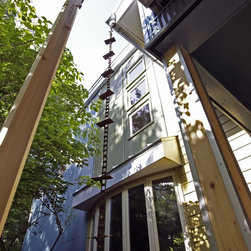
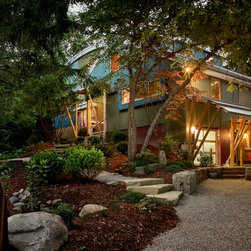
The Nautilus House sprung from a need to fix a leaky roof, and a vision for energy and water independence on a beautiful wooded building site. Like a nautilus, it unfolds in an organic shape spiraling upward and outward on the original foundation, with existing materials and spaces re-inventing themselves within and around the structure. Meadowlark Builders, Architectural Resource and the homeowner worked together to create a unique vision of home that was Michigan’s second LEED® Platinum residential remodel.
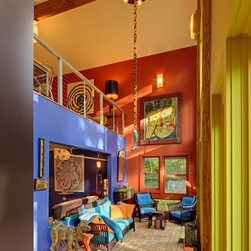
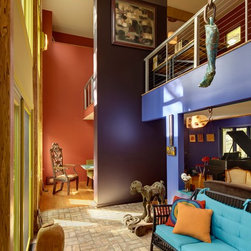
Reorganizing the flow of the home to create flexible and open spaces allowed the home to keep its original small cottage footprint and let the outdoors in. Smaller, well-organized homes can be intimate and friendly while keeping resource use to a minimum.
The Nautilus House utilizes small footprint drilling technology to install geothermal heating and cooling on a hilly site. The Earthlinked Technologies® direct exchange geothermal system is not only the most efficient on the market; it also permits the installation of geothermal energy on small or difficult sites. Domestic hot water capability with this geothermal system provides reliable year-round hot water. Backed up by an on-demand hot water heater, this system provides consistent, unending hot water with a low energy cost.
Well-insulated and tight buildings are another crucial step in producing extremely energy efficient homes. The Nautilus House uses several techniques to achieve that goal, including Advanced Framing techniques that replaced about 30% of the lumber used with insulation, SIPs (Structural Insulated Panels) for an extremely efficient and strong roof system, and SPF (Spray Polyurethane Foam) to expand into all the nooks and crannies of the existing framed exterior walls and make them air-tight.
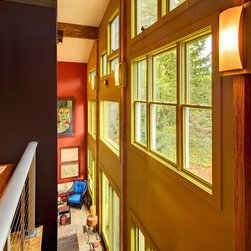
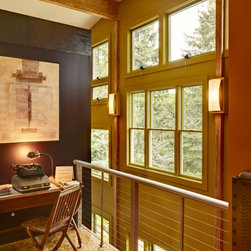
The form of this home arose from the goal of making solar energy on a heavily wooded lot, a challenging trick. A four-kilowatt system provides nearly all of this home’s non-heating electrical requirements. As the roof curves back to expose a thin window of solar opportunity, it also creates a new large loft over the first floor. The house recycles the heated air radiantly through an advanced duct system. The form and openness of the home also take advantage of another product of solar energy – wind – to create convective currents that cool the home passively.
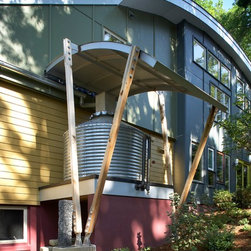
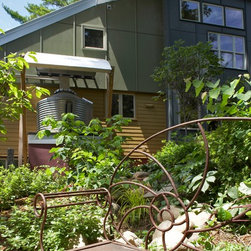
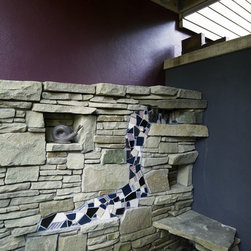
Water conservation and re-use are one of the main goals of this project. This home is designed to collect and store water on site. The 1000-gallon corgal tank becomes part of the architecture of the home. The standing seam metal roof will last far longer than a standard roof and will deliver clean water to rain-saving catchment containers. The front half of the roof structure sends its harvest to a sand-filtered water storage tank in the front, while the rear half goes to rain barrels for use in irrigation of landscaping. Ultra low-flow water fixtures and dual-flush toilets are used through the home.
The exterior of this home is also clad in a rain screen siding detail that holds the cladding material off the surface of the exterior framing. A high-performance vapor shield protects the home from wind and water while allowing interior moisture to pass through. The rain screen also allows the cladding material to dry on both sides, greatly increasing its longevity.
Energy Recovery Ventilators (ERVs) recover the heat & moisture content of stale interior air to condition incoming fresh air. Large amounts of energy are saved by this exchange, while HEPA filtration further optimizes interior air quality.
MIchael Klement Architect: Architectural Resource, Ann Arbor, Michigan
The Nautilus House sprung from a need to fix a leaky roof, and a vision for energy and water independence on a beautiful wooded building site. Like a nautilus, it unfolds in an organic shape spiraling upward and outward on the original foundation, with existing materials and spaces re-inventing themselves within and around the structure. Meadowlark Builders, Architectural Resource and the homeowner worked together to create a unique vision of home that was Michigan’s second LEED® Platinum residential remodel.
Reorganizing the flow of the home to create flexible and open spaces allowed the home to keep its original small cottage footprint and let the outdoors in. Smaller, well-organized homes can be intimate and friendly while keeping resource use to a minimum.
The Nautilus House utilizes small footprint drilling technology to install geothermal heating and cooling on a hilly site. The Earthlinked Technologies® direct exchange geothermal system is not only the most efficient on the market; it also permits the installation of geothermal energy on small or difficult sites. Domestic hot water capability with this geothermal system provides reliable year-round hot water. Backed up by an on-demand hot water heater, this system provides consistent, unending hot water with a low energy cost.
Well-insulated and tight buildings are another crucial step in producing extremely energy efficient homes. The Nautilus House uses several techniques to achieve that goal, including Advanced Framing techniques that replaced about 30% of the lumber used with insulation, SIPs (Structural Insulated Panels) for an extremely efficient and strong roof system, and SPF (Spray Polyurethane Foam) to expand into all the nooks and crannies of the existing framed exterior walls and make them air-tight.
The form of this home arose from the goal of making solar energy on a heavily wooded lot, a challenging trick. A four-kilowatt system provides nearly all of this home’s non-heating electrical requirements. As the roof curves back to expose a thin window of solar opportunity, it also creates a new large loft over the first floor. The house recycles the heated air radiantly through an advanced duct system. The form and openness of the home also take advantage of another product of solar energy – wind – to create convective currents that cool the home passively.
Water conservation and re-use are one of the main goals of this project. This home is designed to collect and store water on site. The 1000-gallon corgal tank becomes part of the architecture of the home. The standing seam metal roof will last far longer than a standard roof and will deliver clean water to rain-saving catchment containers. The front half of the roof structure sends its harvest to a sand-filtered water storage tank in the front, while the rear half goes to rain barrels for use in irrigation of landscaping. Ultra low-flow water fixtures and dual-flush toilets are used through the home.
The exterior of this home is also clad in a rain screen siding detail that holds the cladding material off the surface of the exterior framing. A high-performance vapor shield protects the home from wind and water while allowing interior moisture to pass through. The rain screen also allows the cladding material to dry on both sides, greatly increasing its longevity.
Energy Recovery Ventilators (ERVs) recover the heat & moisture content of stale interior air to condition incoming fresh air. Large amounts of energy are saved by this exchange, while HEPA filtration further optimizes interior air quality.
MIchael Klement Architect: Architectural Resource, Ann Arbor, Michigan
Project Year: 2008
Project Cost: $500,001 - $750,000
Country: United States