

North River Residence
Our clients, with their four children, had dreams of casual, rural living close to an urban setting. Visions of old Texas farmhouses, pig-wire fences, and aged wood floors were imagined by our clients. This was to be a “homestead,” a house that would accommodate the active lives of a large family while providing a restful and relaxing setting reminiscent of our female client's rural Canadian upbringing.
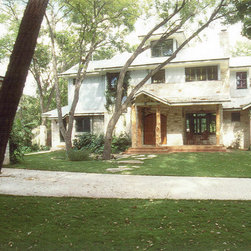
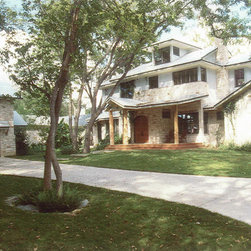
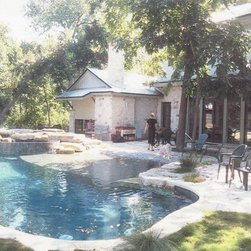
The residence is comprised of a main house, a detached garage with an art studio above, and a pool that is made up of waterfalls and a gentle sloping “beach” edge for a relaxed entry into the water. The pool is used to obscure the boundary between the house and its Lake Austin setting, giving the house claim to this outside activity. Another way the house embraces its immediate surroundings is by the use of stripped juniper trees as columns for porches and covered walkways – helping it blend in with the cedars and oaks found throughout the site.
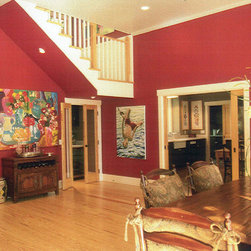
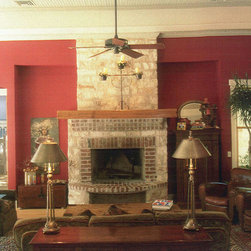
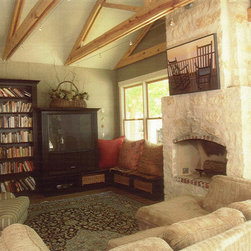
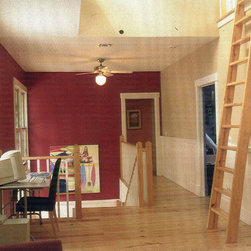
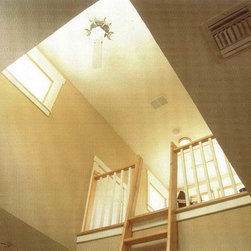
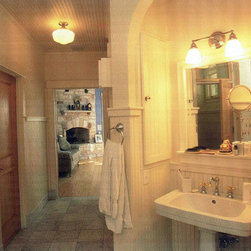
Activities are clustered together, sharing space in large open areas. The dining and living areas are grouped together and are linked to the family room with the kitchen serving as a lynch pin. Physical connections are made with the outdoors using multiple French doors, full height double hung windows, and a covered patio serving as a transition space. Acting to balance out the large open areas that accommodate family interaction, nooks and niches are sprinkled throughout for individual activity. Children’s bedrooms are placed around a common den, and a loft space or “tree house” which is perched atop the second floor. Reached by a ladder, this nook provides a wonderful setting for sleepovers, to say nothing of a cool indoor kids “fort”. The tree house has another important role, that being a thermal siphon to enhance natural ventilation in the home. Natural breezes from the southeast enter the house from 1st level lakeside windows and exit through northwest facing leeward side windows at the highest point in the house, at the loft. Individual pedestal lavs are located in alcoves in the master bath.
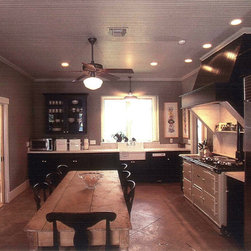
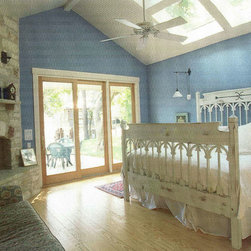
Our client’s ephemeral visions became articulated with utility grade 2x6 tongue & groove yellow pine floors, painted bead board wainscoting and painted wood ceilings. Flattened eating ware - forks, knives, spoons and other kitchen utensils were pressed into the concrete kitchen floors by the family members to personalize the home with an informal stamp during the pouring of the foundation. By situating the house in a climatically responsive manner, sensibly arranging rooms and articulating spaces to reflect the way this family really lives, and using prudent construction practices this house demonstrates casual living in an environmentally responsible manner.
“Green” feature specifics: Locally quarried limestone wraps the ground floor and anchors the house to the site. The metal roof is a screw down galvalume roof made from high recycled-content metal which has a very low heat emmissivity rating and is self venting to reduce heat gain. “Airtight” construction utilizing low permeability building wrap and careful sealing around penetrations, site-specific overhangs and window placement, and a "dual vent path" radiant barrier roof system all work together to keep the interiors cool - reducing energy consumption and allowing for a "downsized" HVAC system. This results in lower construction costs as well as very low operating costs throughout the lifetime of the structure. A "hydronic" heating system also saves energy by making more efficient use of the water heater - a 92% efficient stainless steel "Polaris" model. Wet blown cellulose, a recycled and low toxicity material, replaces the typical fiberglass batting for the insulation. The ceiling has a layer of 1/2” foam thermally insolating the ceiling drywall from the roof framing. This makes for a cooler upper floor and helps prevent condensation of warm moist attic air on the cool ceiling during the summer. A chemical free "sand barrier" termite protection system is utilized in and around the foundation - eliminating ground water pollution and the potential for harmful vapors to infiltrate the living areas of the house.
The residence is comprised of a main house, a detached garage with an art studio above, and a pool that is made up of waterfalls and a gentle sloping “beach” edge for a relaxed entry into the water. The pool is used to obscure the boundary between the house and its Lake Austin setting, giving the house claim to this outside activity. Another way the house embraces its immediate surroundings is by the use of stripped juniper trees as columns for porches and covered walkways – helping it blend in with the cedars and oaks found throughout the site.
Activities are clustered together, sharing space in large open areas. The dining and living areas are grouped together and are linked to the family room with the kitchen serving as a lynch pin. Physical connections are made with the outdoors using multiple French doors, full height double hung windows, and a covered patio serving as a transition space. Acting to balance out the large open areas that accommodate family interaction, nooks and niches are sprinkled throughout for individual activity. Children’s bedrooms are placed around a common den, and a loft space or “tree house” which is perched atop the second floor. Reached by a ladder, this nook provides a wonderful setting for sleepovers, to say nothing of a cool indoor kids “fort”. The tree house has another important role, that being a thermal siphon to enhance natural ventilation in the home. Natural breezes from the southeast enter the house from 1st level lakeside windows and exit through northwest facing leeward side windows at the highest point in the house, at the loft. Individual pedestal lavs are located in alcoves in the master bath.
Our client’s ephemeral visions became articulated with utility grade 2x6 tongue & groove yellow pine floors, painted bead board wainscoting and painted wood ceilings. Flattened eating ware - forks, knives, spoons and other kitchen utensils were pressed into the concrete kitchen floors by the family members to personalize the home with an informal stamp during the pouring of the foundation. By situating the house in a climatically responsive manner, sensibly arranging rooms and articulating spaces to reflect the way this family really lives, and using prudent construction practices this house demonstrates casual living in an environmentally responsible manner.
“Green” feature specifics: Locally quarried limestone wraps the ground floor and anchors the house to the site. The metal roof is a screw down galvalume roof made from high recycled-content metal which has a very low heat emmissivity rating and is self venting to reduce heat gain. “Airtight” construction utilizing low permeability building wrap and careful sealing around penetrations, site-specific overhangs and window placement, and a "dual vent path" radiant barrier roof system all work together to keep the interiors cool - reducing energy consumption and allowing for a "downsized" HVAC system. This results in lower construction costs as well as very low operating costs throughout the lifetime of the structure. A "hydronic" heating system also saves energy by making more efficient use of the water heater - a 92% efficient stainless steel "Polaris" model. Wet blown cellulose, a recycled and low toxicity material, replaces the typical fiberglass batting for the insulation. The ceiling has a layer of 1/2” foam thermally insolating the ceiling drywall from the roof framing. This makes for a cooler upper floor and helps prevent condensation of warm moist attic air on the cool ceiling during the summer. A chemical free "sand barrier" termite protection system is utilized in and around the foundation - eliminating ground water pollution and the potential for harmful vapors to infiltrate the living areas of the house.