
Zen House
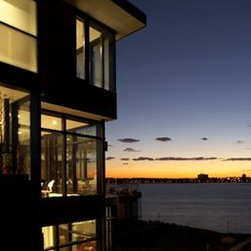
This residence occupies a small waterfront site on a Long Island's shore in a community of post-war homes, predominantly ranches purchased for their great land value, and renovated or replaced by "McMansions.” The owner wanted to take advantage of the site's views of New York City's bridges and skyline and yet seek privacy from adjacent homes.
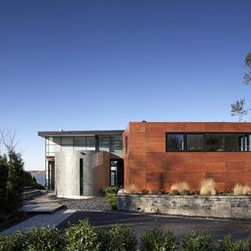
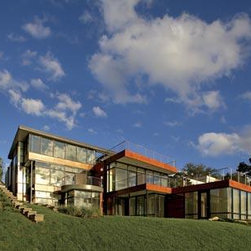
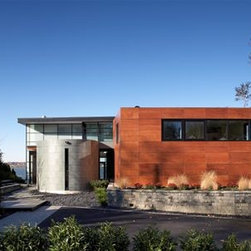
Local building regulations required a total building height of 25', which, because of the site's steep grade, allowed only a low 16' high roofline at the front yard, prescribing a house that appears to be compressed. We responded directly to site considerations and the client program by revealing lower levels as the land drops away. Together with a perpendicular extension, this organization allows for a very private rear yard.
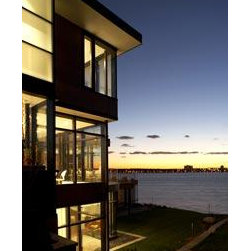
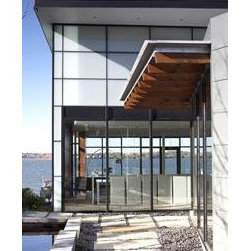
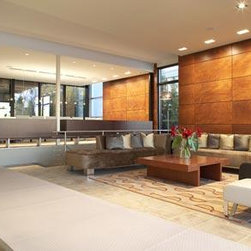
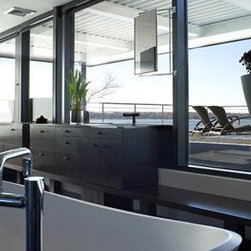
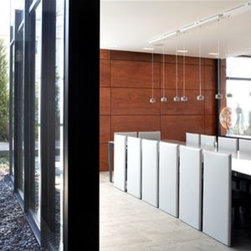
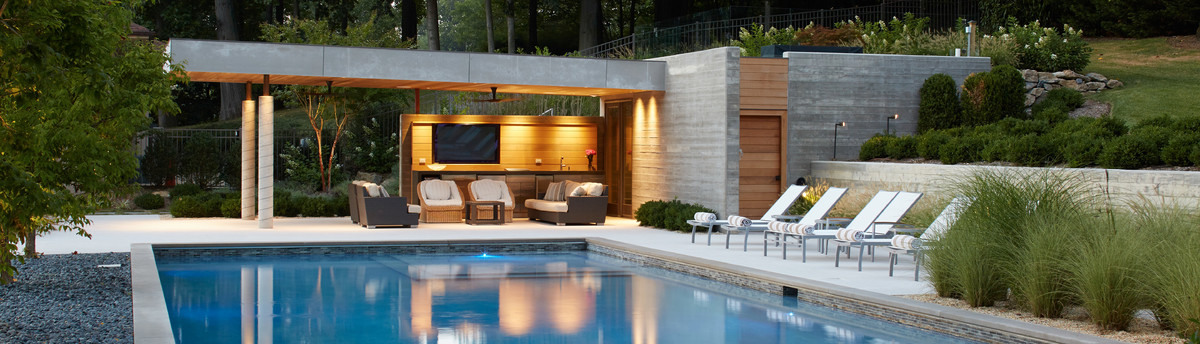
The program for the empty nesters called for open common areas of kitchen, dining room, living room and three bedroom zones of master suite, owner's father and his caretaker, and three guest suites for returning children. Spaces progress from private to public toward the waterfront. To provide a maintenance-free residence and consider waterfront wind codes, the house is built with a steel frame and concrete slabs, which also helped minimize cross-section height. The structure is clad with a resin and wood rain-screen system, zinc, clear and translucent high-impact glazing. The common areas are rendered transparent, allowing physical and visual connection between the winding entry garden with custom-designed granite fountain, rear terrace, and bay. The master suite is left translucent while the bedrooms and infrastructure are rendered as solids.
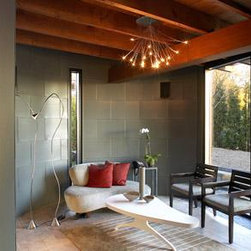
An intimate entry garden surrounds a zinc-clad room (coined the 'Zen room'), the only space with no water view, intended for quiet study and contemplation. Unlike typical suburban front doors, this entry is circuitous, signaling the honest and sustainable approach of a dwelling that does not fall prey to the banal and whimsical use of historical precedent all too common in the area.
Local building regulations required a total building height of 25', which, because of the site's steep grade, allowed only a low 16' high roofline at the front yard, prescribing a house that appears to be compressed. We responded directly to site considerations and the client program by revealing lower levels as the land drops away. Together with a perpendicular extension, this organization allows for a very private rear yard.
The program for the empty nesters called for open common areas of kitchen, dining room, living room and three bedroom zones of master suite, owner's father and his caretaker, and three guest suites for returning children. Spaces progress from private to public toward the waterfront. To provide a maintenance-free residence and consider waterfront wind codes, the house is built with a steel frame and concrete slabs, which also helped minimize cross-section height. The structure is clad with a resin and wood rain-screen system, zinc, clear and translucent high-impact glazing. The common areas are rendered transparent, allowing physical and visual connection between the winding entry garden with custom-designed granite fountain, rear terrace, and bay. The master suite is left translucent while the bedrooms and infrastructure are rendered as solids.
An intimate entry garden surrounds a zinc-clad room (coined the 'Zen room'), the only space with no water view, intended for quiet study and contemplation. Unlike typical suburban front doors, this entry is circuitous, signaling the honest and sustainable approach of a dwelling that does not fall prey to the banal and whimsical use of historical precedent all too common in the area.
Project Year: 2005