





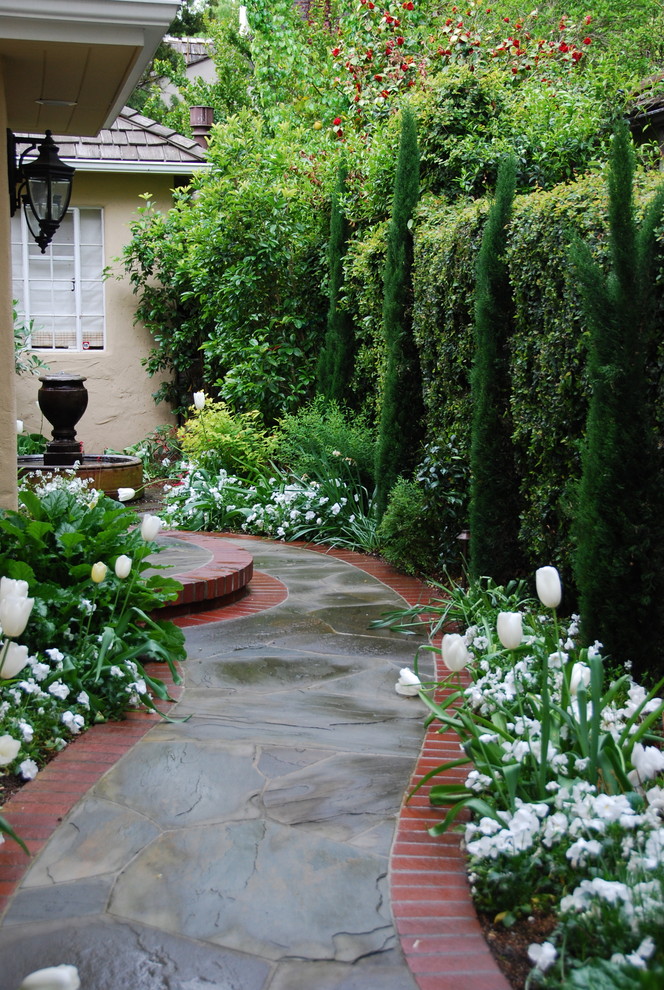
Columnar evergreens provide a rhythmic structure to the flowing bluestone entry walk that terminates in a fountain courtyard. A soothing palette of green and white plantings keeps the space feeling lush and cool. Photo credit: Verdance Fine Garden Design
This photo has 6 questions
suzieliz wrote:
Love your walkway.... Need source info for slate and brick. colors chosen or specific description if possible. »
Verdance Fine Garden Design Thanks for asking. The stone is full-range Connecticut bluestone in a random pattern with irregular (natural) edge; the brick is McNear Common Red. Both are widely used and probably available at a stone yard near you.
-John
Verdance Fine Garden Design Thanks for asking! You are very perceptive: the "hedge" behind the juniper trees actually is a wall covered in Creeping Fig (Ficus pumila). The large shrub in the back corner is English Laurel (Prunus laurocerasus).
John
Creeping Fig was something we saw/had in South FL - Would any of these plants work in Southern IN?? - creeping fig was something we saw/had in South FL. Lovely application. I'm particularly interested in the Italian Cypress - again, would they work in 4 season climate? Thanks »
Verdance Fine Garden Design My expertise is limited somewhat to the San Francisco Bay Area where I design, but a bit of detective work can answer your question.
The U.S. Department of Agriculture publishes a Plant Hardiness Zone Map, which maps the country into zones according to minimum winter temperatures. It's online at http://planthardiness.ars.usda.gov/PHZMWeb/ .
Based on the USDA information, plant growers provide hardiness "ratings" for their plants, indicating the minimum temperature that plant can survive.
Checking the USDA map I see that if you're south of Indianapolis you are in USDA Zone 6, where minimum winter temps average -10° to 0°.
According to Monrovia growers, Creeping Fig (botanical name: Ficus pumila) is hardy to USDA Zone 9, which has a winter minimum of 20° - 25°F, so it probably would not survive your Indiana winters.
Italian Cypress (Cupressus sempervirens) is hardy to USDA Zone 7, which has a minimum of 0° - 5°. This is a better match, although one particularly cold winter could damage or kill this plant. If you absolutely looooved that plant I might risk it; otherwise you might have better success with a plant such as 'Skyrocket' Juniper (see http://www.monrovia.com/plant-catalog/plants/1715/skyrocket-juniper.php), which is hardy down to Zone 4.
rbcola John, Thank you so much for your quick response....Actually I thought the same thing and began to reserach the Italian Cypress but didn't think to explore the USDA Plant Hardiness Zone Map.....so thank you also for that resource and for taking the time to do "my homework" for me. There is a tree that I "discovered" when I moved here that was planted in front of our Wonderlab (a children's science museum) that I have fallen in love with and I plan to put in our landscape design. It's called a Columnar English Oak Quercus robur 'Fastigiata'. (Zones 5-8). Thank you again for your investment in my answer.
Verdance Fine Garden Design Thanks for asking! The "hedge" behind the juniper trees actually is a wall covered in Creeping Fig (Ficus pumila). The large shrub in the back corner is English Laurel (Prunus laurocerasus).
Verdance Fine Garden Design Hi, those actually are white Impatiens. This is a cool-season annual that should be readily available at nurseries. Thanks for asking!
John
Here's an entry garden that gains excitement from a row of slender Italian cypresses emerging like exclamation points in front of a solid hedge. Privacy? Yes. But this is also a gorgeous way to welcome guests and give them a beautiful journey to the front door.
Slate is an exceptional walkway material because it doesn't absorb water, isn't affected by direct sunlight and can stand up to extreme weather conditions. The subtle color palette coordinates nicely with most landscapes.
In monochromatic schemes, the bulbs' main role is to provide design interest rather than color. As a result, you can use fewer bulbs to accomplish the goal. In this photo, small staggered groupings of tulips provide rhythm and repetition, leading the eye down the path to the front door.
16. Anchor tall plantings. In this San Francisco garden, white tulips lend a pristine formality to a brick-edged, curved stone walkway. Punctuated with columnar evergreens, the look is understated and timeless, and can be easily switched once the flowers fade.
If you like the idea of a white garden but don't want to commit to such a large area, try flanking a pathway with a simple springtime combination. White daffodils or tulips could join pansies or white forget-me-nots (Myosotis sp, zones 3 to 8) for an early-season display. In a shadier spot, a mass planting of snowdrops would be delightful.
Columnar evergreens provide a rhythmic structure to the flowing bluestone entry walk that terminates in a fountain courtyard. A soothing palette of green and white plantings keeps the space feeling lush and cool. Photo credit: Verdance Fine Garden Design
Anchor tall plantings. In this San Francisco garden, white tulips lend a pristine formality to a brick-edged, curved stone walkway. Punctuated with columnar evergreens, the look is understated and timeless, & can be easily switched once the flowers fade.
Anchor tall plantings. In this San Francisco garden, white tulips lend a pristine formality to a brick-edged, curved stone walkway. Punctuated with columnar evergreens, the look is understated and timeless, and can be easily switched once the flowers fade.
-John