Software
Houzz Logo Print
mazerolm_3a

Mulching with compost in established bed

2 years ago

Hello,


I’ve always mulched with bags of cedar, but this year I’m planning to mulch all my beds with compost.


Anyone here doing this? How has it worked out for you? Any tips?


Thanks!

Comments (26)

  • 2 years ago
    last modified: 2 years ago

    Unless you're mulching very thickly with compost, you may have more weed growth/germination than with a wood product, but otherwise compost makes for a fine mulch and has all the same benefits of bark or wood chips.

    Compost does also break down a lot faster than wood mulches, which some may see as a downside, but that also means the organic matter is being incorporated into your soil more quickly as well!

    mazerolm_3a thanked sah_upstate4 (zone 5b - NY)
  • 2 years ago

    @sah_upstate4 (zone 5b - NY): I was planning for 2-3 inches thick. Do you think that would be ok?

  • 2 years ago

    @gardengal48 (PNW Z8/9): any tips on when/how to apply mulch? My window is short because as soon as snow melts, crocuses and other early blooming bulbs emerge. It sounds very difficult to put 4 inches of anything around these short plants without covering them. Or am I just overthinking this?


    Thanks!

  • 2 years ago

    I have never spent a penny on mulch in bags. I always use my own compost in the garden and use whatever is ready, whenever it is ready and to no set depth. On the allotment I use compost and whatever leaves and chippings the council dumps for us. It isn't difficult to lay around plants. Just fork it around a bit. If you are doing it in winter even easier. Perennials and bulbs will just grow up through it.


  • 2 years ago

    @floraluk2: I can’t do it in winter, as everything is covered by at least 4 feet of snow.


    And early blooming bulbs start to emerge when there’s still snow.


    Do you know if my plants would be harmed, if I accidently cover them with compost when they are growing?


    Thanks!

  • 2 years ago

    I very much doubt if they'll be harmed. In my climate I mulch all year round, whenever I have some compost ready, although it's harder in summer because there are no gaps between the plants.


    Could you do it in autumn?

  • 2 years ago

    @floraluk2: yes, I could. I think I will start this Spring in spots where plants are not so closely planted and do the rest this Fall.


    Thank you!!

  • 2 years ago

    I always use compost.

    mazerolm_3a thanked cyn427 (z. 7, N. VA)
  • 2 years ago

    I use any old stuff which will cover the soil - compost, leaves, grass clippings, chopped up comfrey, old potting mix, even weeds (trash mulch). My soil is sandy, stony, very free draining (although has vastly improved over the years) and my main imperative has always been to protect the structure, prevent leaching and generally feed the soil. I don't care one whit about weeds - I never tread on my soil so weeds pull easily (I leave the weed cover all winter).Doesn't look pretty but is quickly hidden when plants grow and expand.

    mazerolm_3a thanked rosaprimula UK (Cambridge) Z8/9
  • 2 years ago
    last modified: 2 years ago

    @mazerolm_3a, I echo @gardengal48 (PNW Z8/9) post. It doesnt take much to make me happy in the garden and using "home grown" compost (from 6 containers, added to 12 months of the year) is one of them.


    (But as others have commented, be prepared for more weeding)

    mazerolm_3a thanked rouge21_gw (CDN Z5b/6a)
  • PRO
    2 years ago

    I do a lot like rosa in that I'm adding in soil cover a lot of the year. It's mulch, but most of it composts in pretty quickly. Clippings, leaves, gardening scraps. I tend to use my weeds too- they grow and can be green cover, get eaten or not, get pulled and usually dead dropped right back where they came from. I know this is against a lot of folks that pull and haul them off. Weeds steal from the plants and all. And weeds do pull- but I figure it's like robbing a bank. The weeds can rob it, but they can't leave with the nutes unless I'm their get away driver. Weeds that need more stomping death gets tossed into the paths or the cold compost cages. Or occasionally hung to die.

    But compost can be added at different times of year, including winter. Spring can be fill in and around spring poppers. During the summer pretty much any bare spots can get some. Later fall is fine since a lot of the gardens die back and putting on a thicker overall layer is easier. If you like to get out during winter during melt offs or before heavy snows... if you mark off the edges of your beds with poles in the fall, it's easy to find them in the winter. You can throw down compost and soil amendments right onto the snow. The white makes it real easy to see even distribution. And the snow sort of naturally waters the stuff in as it melts.

    mazerolm_3a thanked beesneeds
  • 2 years ago

    Our county offers compost, fine mulch and more coarse mulch at very low price . We mostly buy fine mulch as mulch for the beds. They provide good barrier and water protection but also decompose relatively fast. We apply it every spring

    mazerolm_3a thanked forever_a_newbie_VA8
  • 2 years ago

    @mazerolm_3a Any kind of bulb plant is going to just laugh at a 4-inch mulch layer and then pop right through. I have a raised bed with about 12 inches of succulent soil on top of the clay loam soil, which holds sever bulbs. The bulbs worked their way all through that soil and pop up reliably every Spring. Bulb plants tend to be persistent and aggressive in playing out their bloom cycle.

    mazerolm_3a thanked westes Zone 9b California SF Bay
  • 2 years ago

    Well I’m getting 8 cubic yards of compost delivered this Friday. My back is sore just thinking about it! 😆

  • 2 years ago

    Im not trying to be sarcastic but dead serious . Do you know how much space 8 yards will take up? A lot! please take a picture of it and one of yourself before and after moving it!

    i fear for your back. Hire help.

  • 2 years ago

    Thanks @Marie Tulin: you’re very kind! I can have help at home should I need it (2 teenage sons) but I enjoy doing this and I’m still in a decent enough shape that I can do most of the work myself.


    I’ve been slowly spreading compost all week-end, taking many breaks in between.


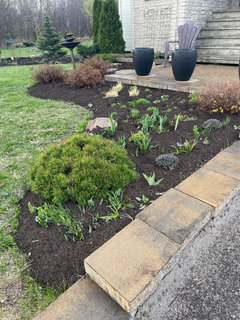
    I did not take out my measuring tape but I was unable to add 4 inches thick. Otherwise I would have smothered my plants. It still seems like a decent depth, so we’ll see how that goes.


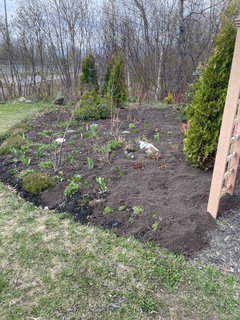
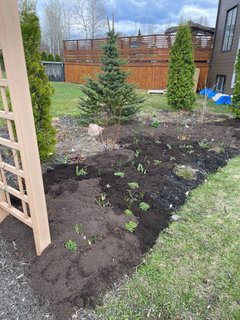
    I did not take before pics, but here’s one section that’s done:


    The other side of the arbor is still in progress:


    I can’t wait for plants to start growing! :)


  • 2 years ago

    I would like to know what you all do about seeds you hope to germinate, like poppies, verbena, and ammi majus… That’s what holds me up from mulching til late May, which means doing a lot of weeding. I keep asking myself if they’re worth it. Or is there a strategy I‘m missing?

  • 2 years ago

    @kitasei: I probably buried a lot of penstemon, lupine and echinacea seedlings in the process, but in previous weeks I potted a lot of small plants that will go in the beds in a few weeks.


    I don't think I will do this every year, it's too much work.

  • 2 years ago
    last modified: 2 years ago

    @rosaprimula, just curious how one goes about hot composting a mountain of green and brown materials? If costs wasn't an option, I'd have a huge mechanical , chipper,grinder, mixer. Unfortunately it will be vast amounts of physical exsertion. Sorry about spelling.

  • 2 years ago

    @mazerolm_3a It is a lot of work to spread out compost from scratch on a large garden bed. That is what made me start using three to four inches of composted arborist material. That not only does a great job of moisture retention and blanketing the soil layer, but it degrades and further composts very slowly. If you pile it on four inches thick, you can wait three years to re-apply it. By contrast, compost seems to degrade down in one season.

    mazerolm_3a thanked westes Zone 9b California SF Bay
  • 2 years ago

    Is “composted arborist material” the same thing as the pile of wood chips that lies around a year in my driveway before I get to spreading it?

  • 2 years ago
    last modified: 2 years ago

    @kitasei2 In my area near San Jose, California, there are two types of "compost" sold:

    * Yard waste compost, which is made from plant materials collected by the garbage company, and composted to a fine brown powder. This stuff works well but decomposes quickly

    * Arborist waste compost, which is made from wood chips, but after a long composting process. I would guess that it is about 50% to 60% composted.

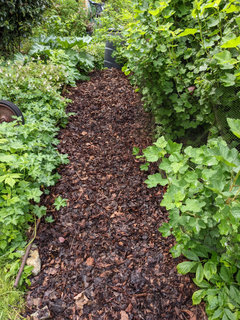
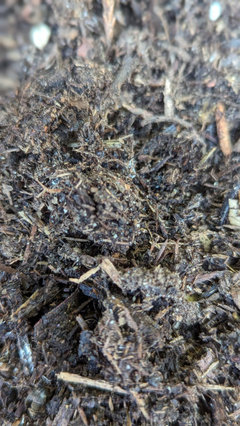
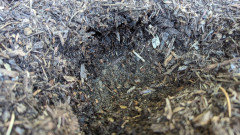
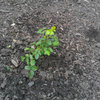
    The wood chips you spread might not compost the same way since they do not always include the green leaf material. The first photo shows what my material looks like. If yours looks similar after two years on the ground, then great.

    However they make it, this arborist waste compost is extremely rich. You can see in the first photo the various layers of composting and some evidence of white fungal communities. Any plant I stick into that arborist waste compost grows quickly.

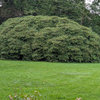
    The second photo shows the soil below my four inch mulch layer, which stays moist and well conditioned even in the middle of Summer.


    mazerolm_3a thanked westes Zone 9b California SF Bay
  • 2 years ago

    I would like to know what you all do about seeds you hope to germinate, like poppies, verbena, and ammi majus…


    Referring to "wood chips":


    https://www.plantparadisecountrygardens.ca/the-gardeners-journal/why-not-to-mulch-your-gardens/


    mazerolm_3a thanked rouge21_gw (CDN Z5b/6a)
  • 2 years ago

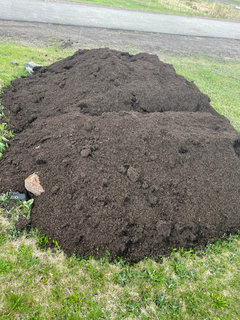
    Got another one done:


    Here’s the rest of the pile:


    Good thing there is lots left because I have 6 more beds to do!

  • 2 years ago
    last modified: 2 years ago

    Heya Jay, I think the size of the heap(s), regular moisture addition (I put the hose on for a couple of hours) and tons of aeration. can generate an astonishing amount of heat in the middle of each pile. I have a 5m long area, enclosed on 3 sides and divided into 3 bays. The divisions between each bay consist of moveable planks of wood - 2 bays always in use and an empty one for rotating/turning in the composted materials. It is much easier to fork the heap into the next door bay. I should turn the heaps more frequently than I do (or can press the maternal thumb on the offspring). I put all my household veggie waste, all the clippings, prunings and weedings from the allotment (an insane amount of...stuff) butI can still only manage around 3 -4 tonnes of finished compost in any year...and as for leaf mould - it vanishes down to minuscule amounts. I never come anywhere near to having enough compost to spread it around as mulch. It nearly always goes in the service of the small amount of vegetables I still grow, with the leafmould and worm compost being saved for my best perennial seedlings and young plants still in pots. No chance of mulching any of the perennial beds ...but I squeeze a lot of annual fillers, anywhere there is an inch or so of space - filling every bit of soil with things I do want is the only way to keep things I don't want, out of the beds.

    I don't do this in the veggie beds (or not much) as I leave space to hoe and top-dress