Software
Houzz Logo Print
kelsey_helland5

Using Smart Panel (Span) to Avoid Main Panel Upgrade?

5 years ago

We are renovating in San Francisco and, in the process, switching our home to all-electric (cutting gas) and adding solar and a battery. We thought our project was going to require an expensive upgrade of our main/service electrical panel, due to the new electric appliances — even though we would probably be drawing less from the grid with out solar and battery.

However, I just learned about smart panels from Span. They advertise that using a smart panel can sometimes avoid needing to do main panel upgrades. https://www.span.io/.

Has anyone in SF used Span as a way to avoid needing to do a main panel upgrade? Did you run into any issues with code requirements, or PG&E policies, that added friction to the process? Please let me know!

Thanks,
Kelsey

Comments (13)

  • 5 years ago

    According to the web site, it is a replacement for a traditional electrical panel with phone control added.. You need and electrical load analysis to determine what size (100 amp - 400 amp) panel you need given the "new" appliances (maybe you existing panel can handle the new load). There are places on the net that can help you do that analysis.

  • 5 years ago

    Can you explain a little more what the upgrade is that you're concerned about? To use this smart panel, it seems like you would have to remove your existing panel and wire this in, and I'm not clear on how that would be less expensive than simply putting in a larger capacity breaker box or a sub-panel. Do you have information that leads you to believe that your project would otherwise require you having to replace your existing service cables with larger gauge cables, and this smart panel will prevent you having to do this (and you think that new cabling would be a huge expense)?

  • 5 years ago
    last modified: 5 years ago

    It's not how much you're drawing from the grid but how much you are drawing in total. This assuming that you load balance (grid + solar) before your panel which is typical. (The other option would be to have one panel for grid connected circuits and one for solar connected circuits but I'd recommend against that.)

    Also, there are still likely to be cases where you will be 100% grid unless you are OK with not having some electrical things available when solar+battery is not available.

    So, I think you will likely still need a panel capable of handling the entire electrical load of your house in order to meet code.

    I believe Span uses standard dumb breakers and just has their electronics behind it. A significant problem w/ new electrical panels is AFCI nusiance trips (think having to reset a breaker once per week or day). Some panels such as Square D's new stuff are doing a much better job than others such as Eaton or Siemens so something to think about.

  • 5 years ago

    Thanks for the responses. Just to clarify: it’s my understanding that there is a requirement in SF (either building code or PG&E policy) that the main/service panel must be rated to handle the amperage of the entire home load as if it were all turned on at once, even though (a) we will never have everything turned on at once; and (b) most of our power will come from our new solar + battery. I’m hoping to find out if anyone has experience getting around that requirement using a smart sub-panel, which is one of the selling points on Span’s website.

  • 5 years ago

    Kelsey-

    I know you're looking for relevant personal experiences, but you might also get useful info by talking with tech support folks at Span.

  • 5 years ago

    Thanks; I’ve already scheduled that, but they aren’t available for over a week, and I’m trying to get info ASAP in case I need to modify my plan with PG&E and my contractors.

  • 5 years ago

    How to get around the SF electrical policy: Disconnect from their grid. You're looking for a work-around for a policy you don't like. It's not going to happen. Live with their rules or disconnect.


  • 3 years ago

    Hi Kelsey, can you share what your resolution was for this? We’re half way through electrifying and up against the exact same issue—we have 100A service, and installing a heat pump will run up against that, unless a smart panel can help better manage loads and avoid an upgrade.

  • 2 years ago
    last modified: 2 years ago

    Hi Kelsey, we are going through the same decision process in Tiburon. Any follow up on your experience and leads to help with this process would be so helpful

  • 2 years ago
    last modified: 2 years ago

    Christopher - it’s gone very well for us. Can you send me a message? I can provide more info.

  • 2 years ago

    We ended up getting the Span (Kelsey thank you for your offer above!), and it's worked out fine--we still have 100A service, but were able to complete a full electrification.


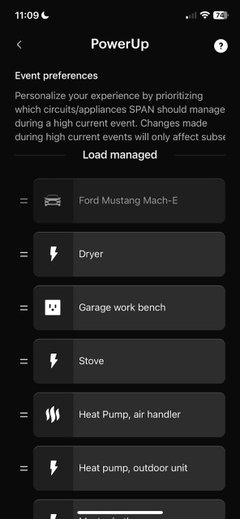
    Span now has a feature called "PowerUp" which meets NEC standards for Energy Management Systems, and lets you prioritize circuits to shut down if the panel detects load is getting too high. It would be hard for us to overload our service, but we technically could. With this configured, basically our car would stop charging and maybe the dryer would get shut off, and we'd be fine. Here are the docs, and a screenshot of how you prioritize circuits on the Span app.


  • 2 years ago
    last modified: 2 years ago

    @Kelsey I cant seem to find a way to dieect message you. I’ll put my email here and delete the comment later if you wouldnt mind reaching out to me first. :) chrisyoo.sf@gmail.com

    @John great to hear its worked out for uou as well. i read about the Power Up add on and hoped it would work just the way you described in real life use. i was just picturing scenario of Thanksgiving dinner using the induction stove, oven, heat pump, maybe separate hot water heater and dryer on top of all the lights, fridges, hair dryer, etc l. Would love to hear your real life electrification story as well if you have time. ive gone down the youtube rabbit hole, deep…